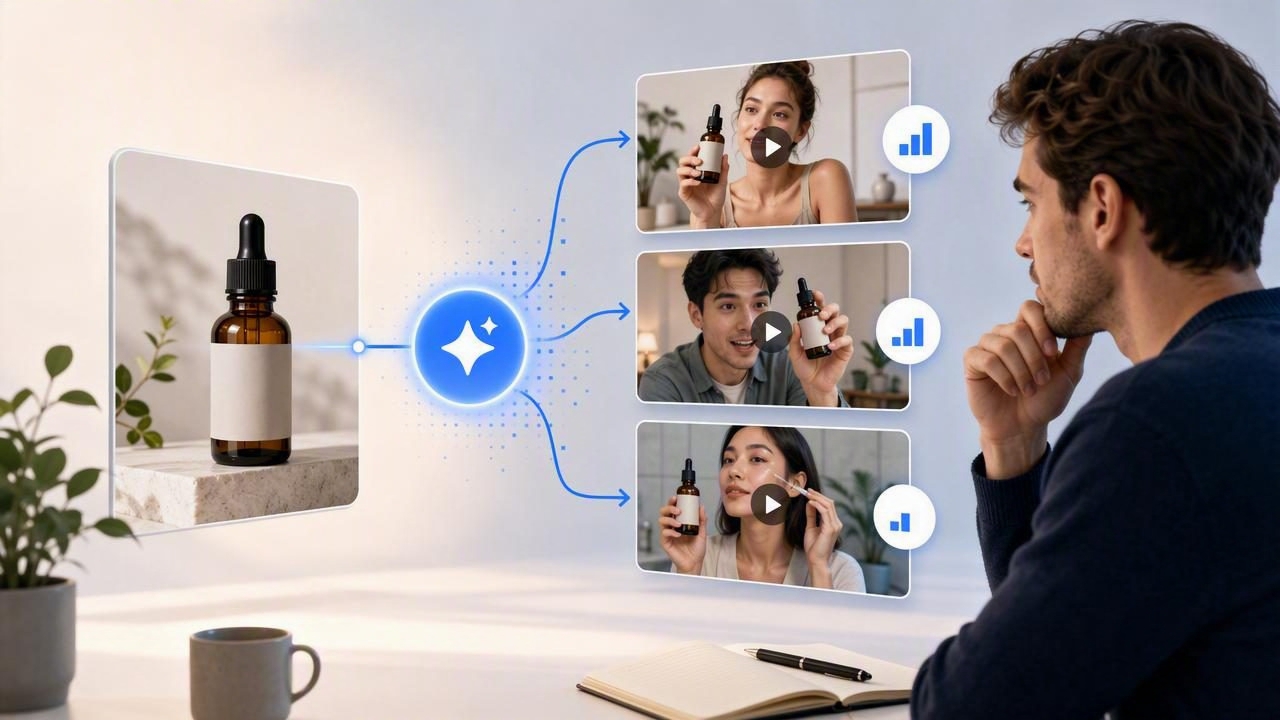
For a product founder, the hardest part of video marketing is often not deciding that video matters. It is deciding which video idea deserves attention first. A single product photo can support multiple directions: a creator-style unboxing, a problem-and-solution demonstration, a gift-focused angle, or a quick comparison of an old method versus a new one.
An AI video ad creator can help you prepare and evaluate these directions before committing substantial time to a shoot. Instead of treating one product image as a finished ad, use it as the visual reference for a set of clearly different UGC-style video concepts. The objective is not to assume that generated creative will produce a particular sales result. It is to create a better starting point for creative review, messaging decisions, and future testing.
This guide explains a practical way to turn one product image into comparable AI-generated video ad concepts, with a concrete example, a review framework, and important limitations to keep in mind.
Why product founders need concept comparison before production
Early-stage brands usually have limited creative resources. A founder may have a polished packshot, a product page, several customer questions, and many possible ad messages—but not an in-house production team ready to film every angle.
That makes concept comparison valuable. Rather than asking, “What is the one perfect video?” ask these more useful questions:
- Which opening makes the product’s purpose easiest to understand?
- Which customer problem is specific enough to feel relevant?
- Does the product need a visual demonstration, a lifestyle context, or both?
- Which claim can be supported accurately by product information?
- Which creative direction is worth developing into a fuller campaign?
A product photo provides visual consistency: the correct packaging, color, shape, logo placement, and physical details. AI-generated UGC-style videos can then be used to explore how that product might be introduced in different creator-led scenarios. This is particularly useful when the core product image is strong but the marketing story is still undecided.
Start with a product image that can survive close attention
The source image affects every concept built from it. Use a current, high-resolution image that shows the product clearly and matches what customers will actually receive. If the packaging, ingredients, finish, size, or branding has changed, update the image before creating any video concepts.
Before you begin, make a short product fact sheet. This prevents the creative brief from drifting into vague or unsupported messaging.
| Information to prepare | Why it matters for video concepts |
|---|---|
| Product name and category | Keeps the hook and on-screen text clear. |
| Primary use case | Determines the problem or moment shown in the story. |
| Verified features | Helps avoid claims the product cannot support. |
| Audience context | Guides tone, setting, and creator perspective. |
| Required disclaimers | Ensures review requirements are considered early. |
| Visual restrictions | Prevents inaccurate colors, labels, or implied uses. |
Also decide what the image cannot communicate by itself. A product photo may show a compact travel bottle, for example, but it cannot prove that it is leakproof, universally suitable, or preferred by customers. Separate visible facts from marketing assumptions before writing a concept.
A concrete example: one skincare product, three UGC-style concepts
Imagine a founder selling a facial moisturizer in a clean white pump bottle. The available asset is one front-facing product image on a neutral background. The verified product information says it is a daily moisturizer designed for a simple morning routine. The founder wants to explore short-form video ads for people who feel rushed before work.
Rather than generate several near-identical clips, create three concepts with one shared product image and one controlled variable: the main message.
Concept A: The rushed-morning routine
Hook: “My morning routine got simpler when I stopped adding five extra steps.”
The creator-style scene begins in a bathroom or bedroom setting. The product appears early, followed by a simple application moment and a text overlay such as “One everyday step.” The storytelling focus is speed and routine simplicity.
What this concept helps evaluate: Whether the audience responds more strongly to time-saving language than to ingredient or appearance-focused messaging.
Concept B: The vanity clean-up angle
Hook: “The product I actually keep within reach every morning.”
This direction frames the item as a reliable, visible part of an organized routine. The product image is used as the visual reference, while the video concept emphasizes placement, repeat use, and a calm personal ritual.
What this concept helps evaluate: Whether a lifestyle and habit-based narrative communicates value more clearly than a direct problem statement.
Concept C: The beginner-friendly routine
Hook: “If your skincare routine feels complicated, start here.”
The creator explains that a daily routine does not need to be overwhelming, then presents the moisturizer as one simple step. This is not a promise of a skin outcome. It is a creative angle focused on reducing decision fatigue for beginners.
What this concept helps evaluate: Whether education and reassurance are more compelling than convenience or lifestyle framing.
Important: These are creative examples, not evidence of actual product performance, customer sentiment, or advertising results. Product founders should verify all spoken and written claims before publishing.
Use a consistent comparison brief
Comparing concepts only works when the concepts are genuinely distinct while the basic production conditions remain similar. If one idea has a stronger product image, longer script, better call to action, and different audience at the same time, it becomes difficult to identify why it feels more persuasive.
Keep the following elements consistent across your first round:
- The same product image and accurate product representation.
- A similar video length, such as 15 to 25 seconds.
- One audience segment, such as rushed professionals.
- The same primary call to action.
- A similar vertical, short-form format.
- Comparable use of captions and product visibility.
Then vary one strategic element: the hook, problem, use moment, creator persona, or objection addressed. This makes the review more disciplined and gives each concept a clear job.
Write prompts like a creative brief, not a wish list
Generic directions such as “make a viral UGC ad” rarely define a usable concept. A better prompt gives the AI enough context to establish the scene, sequence, voice, and constraints without making unsupported claims.
Format: Vertical creator-style product video, approximately 20 seconds.
Product reference: White pump-bottle daily facial moisturizer.
Audience: Busy professionals building a simple morning routine.
Concept: Rushed-morning routine.
Opening: Creator says, “My morning routine got simpler.”
Sequence: Show product early, then an everyday application moment,
then product close-up with caption: “A simple daily step.”
Tone: Natural, practical, calm.
Avoid: Before-and-after claims, medical claims, guarantees,
inaccurate packaging details, and invented customer quotes.
CTA: Learn more about the daily routine.
Notice that the prompt explains what the video should communicate and what it should avoid. The restrictions are as important as the style notes. They protect brand accuracy and make internal review easier.
How to compare AI-generated video concepts
Do not choose a concept solely because it looks polished. Visual storytelling for product marketing should make the offer understandable, credible, and relevant. Review each concept using a simple scoring table before selecting one for refinement.
| Review question | What to look for |
|---|---|
| Is the hook immediate? | The first seconds establish a recognizable problem, desire, or use moment. |
| Is the product clear? | The product is visible early and is not treated as a background prop. |
| Is the message specific? | The viewer can explain the core idea in one sentence. |
| Does the story fit the audience? | The setting, language, and pace match the intended buyer context. |
| Are the claims safe? | Statements align with verified product information and applicable rules. |
| Is the next step clear? | The call to action matches the stage of awareness and campaign goal. |
For the moisturizer example, Concept A may score highest for immediate clarity because “rushed morning” is easy to recognize. Concept C may be stronger if the brand’s audience needs basic routine education. Concept B may best support a softer brand identity but may need a clearer product benefit to work as direct-response creative. These are hypotheses to review—not predicted performance outcomes.
Know the limitations of AI-generated UGC-style video
AI-generated creative can accelerate concept development, but it does not replace product verification, legal review, or an understanding of your audience. Treat every output as a draft that needs human judgment.
- Product fidelity can vary: Check labels, cap shapes, colors, quantities, and product handling against the original asset.
- Generated scenes can imply things: A setting or action may suggest a use case you do not want to claim.
- Natural language still requires review: Creator-style dialogue can sound believable while containing vague, exaggerated, or unapproved statements.
- Authentic style is not proof: A UGC-style format may feel personal, but it is not a real customer testimonial unless it comes from a real customer and is used with appropriate permission.
- One concept is not a strategy: Distribution, landing-page alignment, audience targeting, and ongoing creative learning remain essential.
Turn the strongest concept into a useful testing plan
After reviewing your initial concepts, select one direction and create controlled refinements. If the rushed-morning angle appears clearest, keep that idea while testing a different first line, visual order, or call to action. Avoid changing everything at once.
For example, preserve the same routine story but compare these hooks:
- “My morning routine got simpler.”
- “I stopped overthinking my morning skincare.”
- “One step I keep in my weekday routine.”
Each line expresses a related idea but emphasizes a different motivation: saving time, reducing complexity, or building consistency. This approach produces more useful creative learning than making unrelated videos with no shared basis for comparison.
Build clearer video marketing from one reliable image
A product image does not have to be limited to a static product page or social post. Used carefully, it can become the foundation for several AI-generated UGC-style video concepts that explore different hooks, stories, and buyer motivations. The key is to compare ideas deliberately, hold key variables steady, and distinguish creative exploration from verified product outcomes.
For a closer look at preparing a source image and shaping a product-led video concept, the UGCMade guide to turning a product photo into video offers additional practical context.