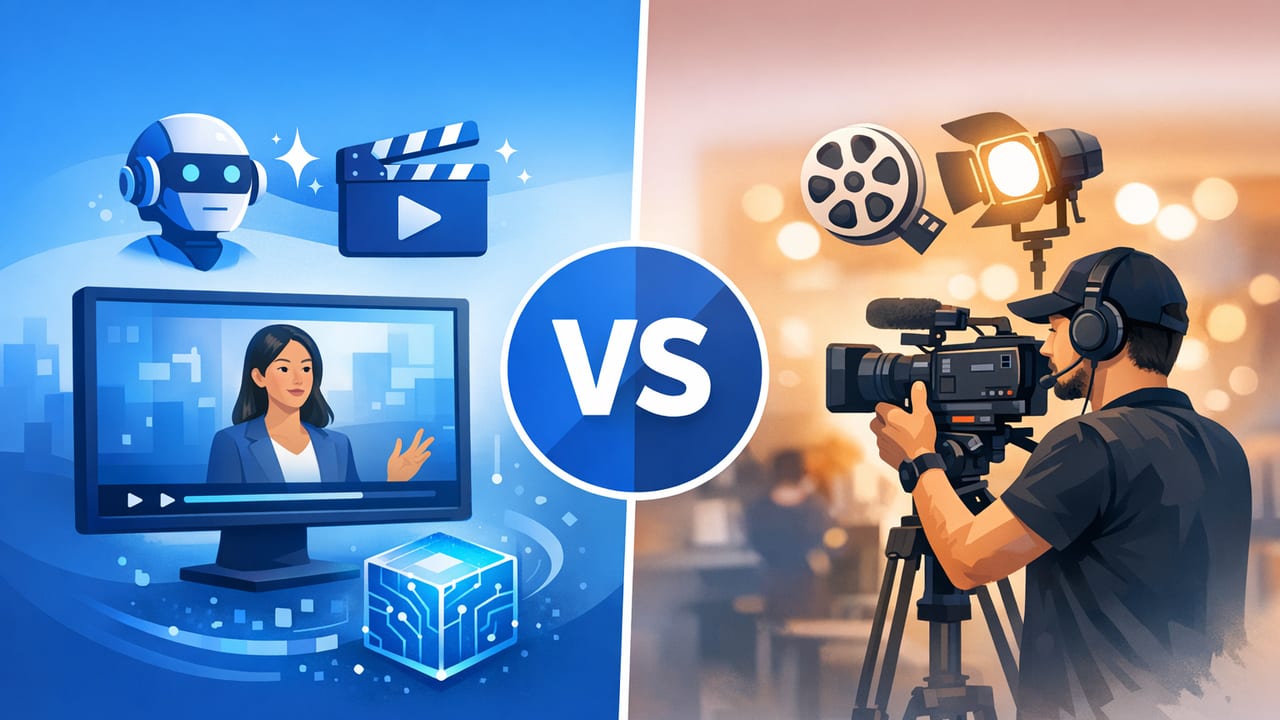
If you’re trying to compare AI videos vs hiring a videographer, the right choice usually depends less on “which is better” and more on what you’re producing, how fast you need it, and how often you’ll repeat the process. Brands today can generate product videos from existing visuals in hours, or invest in a traditional shoot for premium storytelling. Both routes can perform well—when matched to the right goal.
This guide breaks down the real-world differences in cost, time, creative control, production quality, scalability, and provides a practical decision framework you can use before your next campaign.
What “AI video” and “videographer” typically mean
AI video (common workflows)
In product marketing, “AI video” usually refers to tools that turn product photos and text into short clips using templates, motion effects, dynamic text overlays, voiceover generation, music, and automated resizing for formats like 9:16 or 1:1. Many teams use AI to:
- Create variants at scale (different hooks, CTAs, aspect ratios)
- Refresh creative weekly for paid social
- Build product page videos from existing photos
- Localize messaging for different regions
Hiring a videographer (common scopes)
“Hiring a videographer” can mean anything from a solo creator filming on a smartphone to a full crew with lighting, art direction, models, and location fees. A typical professional shoot includes:
- Pre-production: creative concept, shot list, schedule
- Production: filming, lighting, audio, styling
- Post: editing, color, sound mix, motion graphics, exports
Side-by-side comparison: AI videos vs videographer
| Factor | AI videos | Hiring a videographer |
|---|---|---|
| Typical turnaround | Hours to 1–2 days for multiple versions | 1–6+ weeks including planning and revisions |
| Upfront cost | Low; often subscription or per-export | Medium to high; day rates + editing + extras |
| Cost per additional variation | Very low | Moderate to high (edit time, re-shoots) |
| Scalability | High (dozens of ads, SKUs, languages) | Lower (limited by crew and schedule) |
| Control over brand look | Good with templates/brand kits; can feel “templated” if overused | Excellent; bespoke art direction and cinematography |
| Authenticity & human performance | Limited unless using real footage/UGC inputs | Strong (real hands, faces, environments) |
| Best for | Always-on ads, catalog content, rapid testing | Brand films, hero launches, premium storytelling |
Cost: the real numbers to consider
Cost comparisons often go wrong because teams compare a single AI export to a full-service shoot. A fair comparison is: How much does it cost to produce the amount of content you need this month?
When AI tends to be cheaper
- You need 10–50 variations for ads (different hooks, lengths, CTAs)
- You have many SKUs and want consistent formatting
- You want to test quickly, then scale winners
When a videographer can be more cost-effective
- You need a single hero asset that will run for months
- Your product requires demonstration (installation, before/after, complex usage)
- You must capture sound, interviews, or real environments
Rule of thumb: AI usually wins on cost per variation; a videographer often wins on cost per “signature moment” (the shot or performance you can’t fake).
Time and workflow: speed vs certainty
Speed matters because creative fatigue is real: performance often declines as audiences see the same ad repeatedly. AI tools make it easier to refresh assets continuously. A videographer provides a more predictable path to a specific vision—if you have the runway for pre-production and revision cycles.
Speed advantages of AI
- Quick iterations for testing hooks (“Problem → Solution”, “3 benefits”, “Offer-first”)
- Instant resizing and reformatting for different placements
- Batch production across multiple products
Workflow advantages of a videographer
- One shoot day can generate a library: hero edit, cutdowns, behind-the-scenes
- Better control over lighting, textures, reflections (especially important for premium products)
- Higher confidence for PR, retail screens, or investor-facing assets
Quality and creative range: what each can (and can’t) do
Where AI shines
AI is excellent at structured marketing formats:
- Fast-paced benefit stacks with kinetic typography
- Product feature callouts from still images
- Promo-driven creative with strong on-screen text for sound-off viewing
- Consistent brand styling at scale (fonts, colors, layout)
Where a videographer shines
A skilled videographer captures what templates struggle to replicate:
- Human behavior (micro-expressions, trust cues, authentic usage)
- Complex motion (pouring, applying, assembling, unboxing sequences)
- Controlled lighting for glossy, reflective, or luxury materials
- Narrative (story beats that build emotion and brand meaning)
Scalability: how many videos do you need, really?
A useful way to decide is to estimate your “content demand.” If you run paid social, you may need multiple new creatives per week. If you sell through a catalog or marketplace, you might need one short product video per SKU. If you’re launching a flagship product, you may need one hero film plus a few cutdowns.
AI is a strong fit when:
- You need high volume (20+ videos/month)
- You plan systematic A/B testing (hooks, offers, angles)
- You have limited internal production resources
Videographer is a strong fit when:
- You need high impact (brand campaign, retail display, PR)
- Your category relies on trust (beauty application, fitness form, premium materials)
- You’re building a long-term brand library (lifestyle scenes, testimonials)
A decision framework you can use in 10 minutes
- Define the primary goal: testing, conversion, education, or brand story.
- Choose a format: 6–15s ad, 30–60s explainer, product page loop, or hero film.
- List “must-have” shots: hands using product, macro detail, before/after, lifestyle context.
- Check what assets you already have: product photos, pack shots, UGC clips, testimonials.
- Estimate volume: how many variants and how often you’ll refresh.
- Pick the production route: AI, videographer, or hybrid.
Quick scoring checklist
Give each statement 1 point. If you score 5–7, AI-first is usually sensible; if you score 0–2, a videographer-first approach is often better.
- You need 10+ variations (hooks/CTAs/offers) quickly
- You have strong product photos already
- Your placements are mostly social ads or product pages
- You’re optimizing for direct response performance
- You expect creative fatigue and need frequent refreshes
- You sell multiple SKUs with similar structure
- You need localization across regions
Hybrid approach: often the best answer
Many teams combine both methods: use a videographer to capture a core library (hero footage, demonstrations, lifestyle scenes) and use AI to produce high-velocity iterations from that library.
Example hybrid plan
- Quarterly: 1 shoot day to capture 30–60 clips (angles, textures, usage steps).
- Weekly: Generate 10–20 ad variants using different hooks, overlays, and pacing.
- Monthly: Retire losers, double down on winners, refresh thumbnails and first 2 seconds.
Simple ROI math (so the decision isn’t just opinion)
You can estimate whether higher production spend is justified by improved conversion rate or lower CPA. Here’s a simple model:
# Incremental ROI estimate
# (very simplified; adapt to your funnel)

incremental_profit = (visits * (cr_new - cr_old) * profit_per_order) - incremental_cost

# Where:
# visits = traffic driven by the video (ads or site)
# cr_old/cr_new = conversion rates
# profit_per_order = contribution margin
# incremental_cost = extra cost of videographer vs AI production
If a videographer costs $4,000 more than your AI workflow, you can ask: “What conversion lift would we need on 50,000 visits to break even?” This reframes the debate into a measurable experiment.
Brief templates: what to send, depending on your choice
If you’re hiring a videographer (minimum brief)
Product:
Audience:
Primary objective (conversion/education/brand):
Key message (one sentence):
Offer/CTA:
Required shots (bullet list):
Locations/talent needed:
Do/Don't (brand safety, claims):
Deliverables (formats, durations, aspect ratios):
References (links):
Deadline + revision process:
If you’re producing AI videos (minimum inputs)
- Best product photos (front, detail, in-use if available)
- 3–5 core benefits written in plain language
- One offer/CTA and one fallback CTA
- Brand kit basics: logo, colors, fonts (or close equivalents)
- Export specs: 9:16 / 1:1 / 16:9, 15s / 30s, captions on/off
Common pitfalls to avoid (either route)
- Weak first 2 seconds: your hook matters more than polish for performance ads.
- Overproduction without a message: beautiful footage that doesn’t explain “why buy” won’t convert.
- Template fatigue: if AI outputs look too similar, rotate layouts, pacing, and openings.
- No plan for iteration: whether you shoot or generate, you still need testing and refresh cycles.
- Ignoring sound-off viewing: add captions and on-screen text for social placements.
FAQ: compare AI videos vs hiring a videographer
Will AI videos look “cheap”?
They can if you rely on generic templates, mismatched fonts, or low-quality photos. With strong visuals, consistent brand styling, and tight messaging, AI videos can look clean and modern—especially for direct response formats.
Do I still need a videographer if I have great product photos?
Not always. If your product can be understood from images and you primarily need ad iterations, AI may cover most needs. If you need demonstration or human trust cues, a videographer adds value quickly.
What if I need both performance ads and a brand film?
Consider a hybrid plan: shoot a hero story with a videographer, then use AI to generate consistent cutdowns and variants for testing and retargeting.
Conclusion: pick the method that matches your content reality
The most practical answer to “AI videos vs hiring a videographer” is to align production with your content volume, speed requirements, and the type of proof your audience needs. If you’re running frequent tests or managing many SKUs, AI helps you scale. If you’re crafting a flagship narrative or need real-world demonstrations, a videographer earns the investment. For many teams, the best results come from using both strategically.
If you’re exploring AI workflows for turning existing product photos into short video assets, platforms like UGCMade are one example of tooling teams use to streamline that process.