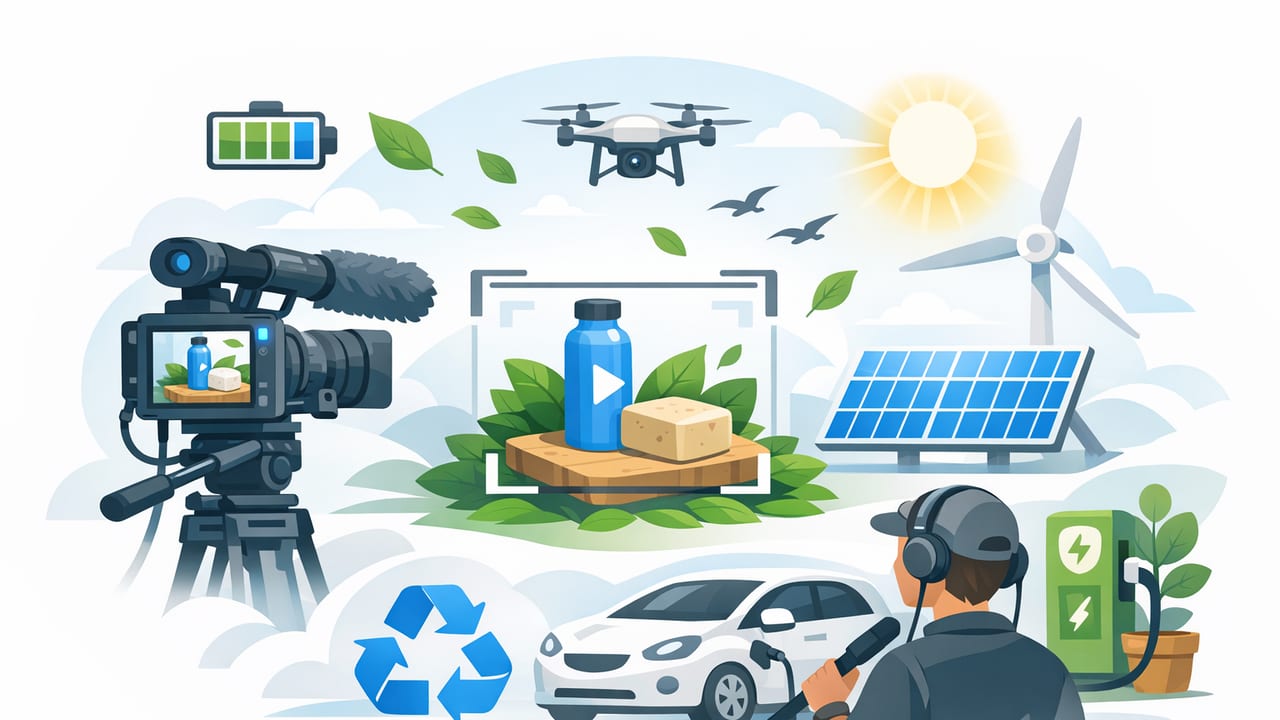
Eco friendly product video production is no longer just a “nice to have.” Video is everywhere—product pages, ads, email, marketplaces—and that volume can quietly increase emissions through travel, shipping, power-hungry gear, and heavy file delivery. The good news: you can reduce impact while keeping quality high by making smarter choices across planning, production, post, and distribution.
This guide breaks down practical steps brands and marketers can use to lower carbon, cut waste, and streamline workflows—especially for product content that needs to be produced at scale.
What makes product video “eco-friendly”?
Eco-friendly doesn’t mean “perfectly carbon-neutral.” It means measurably reducing environmental impact across the video lifecycle while staying transparent about what you did and didn’t change. For product videos, the largest levers typically come from:
- Travel and freight: flights, vehicles, shipping products/props to sets.
- Energy use: lighting, cameras, monitors, workstations, rendering.
- Materials and waste: set builds, single-use props, packaging, wardrobe.
- Data and distribution: storage, transfers, streaming/ads delivery at scale.
Step 1: Plan for low-impact production (before you hit record)
The fastest way to reduce emissions is to avoid them in pre-production. A few decisions here can eliminate entire categories of waste later.
Choose formats that minimize reshoots
Product video often fails because the brief is vague. Re-shoots mean repeat shipping, repeat lighting setups, repeat render cycles. Tighten scope with:
- Shot list by use case: product page hero, 3 benefit clips, 1 FAQ clip, 1 unboxing.
- Template-driven storytelling: consistent hooks, pacing, and CTAs across SKUs.
- Clear “done” criteria: duration, aspect ratios, safe areas, and compliance needs.
Prefer remote and local production where possible
Travel is often the biggest footprint in traditional shoots. Consider:
- Local crews instead of flying a full team.
- Remote direction (live monitor feed + call) to reduce on-site headcount.
- Product-to-creator shipping only when necessary—and consolidated shipments.
Design a “reusable asset” brief
Plan to reuse what you create so you produce less overall:
- Capture clean product angles for multiple edits.
- Build a reusable brand motion kit (logo sting, lower thirds, captions style).
- Standardize music licensing and SFX libraries to avoid repeated searching and re-exporting.
Step 2: Reduce the footprint of the shoot itself
When you do need physical filming, small operational changes add up—especially if you shoot frequently.
Lighting: use efficient fixtures and smarter setups
- LED over tungsten whenever possible (lower power draw, less heat).
- Use diffusion and bounce to get soft light with fewer fixtures.
- Control spill (flags, grids) to avoid “fixing in post” with heavy color work.
Sets and props: minimize build, maximize reuse
- Use modular flats, backdrops, and risers you can reconfigure.
- Rent instead of buying one-off decor.
- Choose recycled/recyclable materials; avoid foamcore and glitter-heavy props that are hard to recycle.
Shipping and packaging: treat it like part of production
For product video, packaging often becomes “production waste.” Improve it by:
- Shipping multiple SKUs together to reduce trips.
- Using right-sized boxes and paper-based void fill.
- Creating a return/reuse loop for samples and creator kits.
Step 3: Consider alternatives to full video shoots for product content
A powerful route to eco friendly product video production is reducing physical production days—especially for catalogs, variants, and frequent refreshes.
In many cases, you can turn existing product photography (or a small set of new photos) into motion-based assets such as slideshows, animated callouts, kinetic typography, or AI-assisted motion sequences. This approach can reduce travel, set waste, and repeated shipping—while still producing platform-native video formats.
| Approach | Typical impact drivers | Best for | Trade-offs |
|---|---|---|---|
| Traditional on-location shoot | Travel, freight, set materials, high lighting power | Hero campaigns, lifestyle storytelling | Higher cost/footprint, longer lead time |
| Local studio + minimal set | Moderate energy use, lower travel | Evergreen product demos, consistent SKU coverage | May feel less “lifestyle” without creative direction |
| Photo-to-video motion (templates/animation) | Compute/render + delivery (often lower than full shoots) | Catalog scale, variants, quick refreshes | Limited to available visuals; needs strong design |
Step 4: Make post-production greener (and faster)
Post-production can be a hidden energy and time sink, especially with heavy codecs, constant re-exports, and inefficient review cycles.
Use efficient editing and review workflows
- Lock the script and shot list early to reduce edit churn.
- Use proxies for smoother editing on lower-power machines.
- Centralize feedback in one tool/thread to avoid version sprawl.
Export with purpose: smaller files can be greener
File size affects storage, transfer, and streaming energy. Optimize without harming quality:
- Match export resolution to placement (don’t ship 4K to a 1080-only placement).
- Use modern codecs when your platform supports them (e.g., H.265/HEVC, AV1).
- Keep bitrates sensible; avoid “max everything” defaults.
Sustainability gains often come from operational discipline: fewer re-dos, fewer versions, smaller files, and less unnecessary movement—of people, products, and data.
A simple way to estimate where your biggest impact is
You don’t need perfect accounting to improve. Start with directional tracking for travel, shipping, and compute time. Here’s a lightweight example (for internal use) to calculate a rough “project footprint score” you can trend over time:
// Rough scoring (not a certified carbon calculator)
// Goal: compare projects and identify big levers

const project = {
  flightMiles: 0,
  carMiles: 120,
  shipments: 3,
  renderHours: 18,
  revisions: 6
};

const score =
  project.flightMiles * 3 +
  project.carMiles * 0.2 +
  project.shipments * 15 +
  project.renderHours * 1 +
  project.revisions * 2;

console.log("Footprint score:", score);
How to use it: don’t compare your score to other companies—compare it to your last project. If your score drops while output quality holds, you’re moving in the right direction.
Step 5: Distribute videos in an eco-conscious way
Distribution can be significant because video is streamed repeatedly. You can reduce impact while keeping performance strong:
Encode and deliver smarter
- Use adaptive streaming so viewers don’t receive unnecessarily high bitrates.
- Create multiple aspect-ratio masters (9:16, 1:1, 16:9) to avoid platforms auto-cropping and reprocessing.
- Host with reputable CDNs and set reasonable cache headers.
Make the creative work harder so the file works less
High-performing videos can reduce waste by lowering the number of impressions needed to reach a goal (sales, signups, click-through). Improve efficiency with:
- Clear first 2 seconds (problem/benefit) to reduce wasted views.
- On-screen text for sound-off environments (better comprehension, fewer repeats).
- Shorter cuts for remarketing (less data transfer per view).
Step 6: Avoid greenwashing in video claims
If your product or brand has sustainability angles, be careful with on-video claims. A few best practices:
- Be specific: say “packaging uses 80% recycled paper” instead of “eco packaging.”
- Qualify clearly: “in select regions,” “for this component,” “compared to our previous version.”
- Keep proof ready: certifications, test results, supplier letters—aligned with your legal/compliance guidance.
A practical checklist for eco friendly product video production
- Brief: define deliverables, placements, aspect ratios, and “done” criteria.
- Travel: local crew + remote direction; consolidate any necessary travel.
- Shipping: batch shipments; reusable packaging; sample return loop.
- Set/props: rent/reuse; recyclable materials; avoid one-off builds.
- Energy: LED lighting; efficient workstation settings; proxies.
- Post: centralized feedback; fewer exports; right-size resolution/bitrate.
- Distribution: adaptive streaming; multiple masters; shorter versions for retargeting.
- Measurement: track a simple score (or carbon estimate) and improve project-over-project.
Example: a lower-waste product video workflow for a 50-SKU drop
Here’s a realistic approach that balances creative needs with sustainability:
- Film one hero day for lifestyle footage (local studio or local location).
- Capture consistent product photos (angles and detail shots) for every SKU.
- Generate templated motion videos for each SKU (benefit callouts + price/offer frames).
- Export platform-native versions (9:16 for short-form, 1:1 for feeds, 16:9 for product pages).
- A/B test 2 hooks across the set to reduce wasted spend and impressions.
This model reduces repeated shipping and repeated on-set time, while still delivering varied video assets that look intentional—not recycled.
Conclusion: sustainable video is a systems problem
The most reliable path to eco friendly product video production isn’t a single “green” trick—it’s building a system that avoids rework, minimizes physical movement, uses energy efficiently, and distributes files intelligently. Start with one change (like consolidating shipments or standardizing templates), track results, and iterate.
If you’re exploring photo-to-video workflows as part of a lower-waste content strategy, tools that convert product images into videos—such as UGCMade—can be one practical option alongside local shoots and reusable production templates.