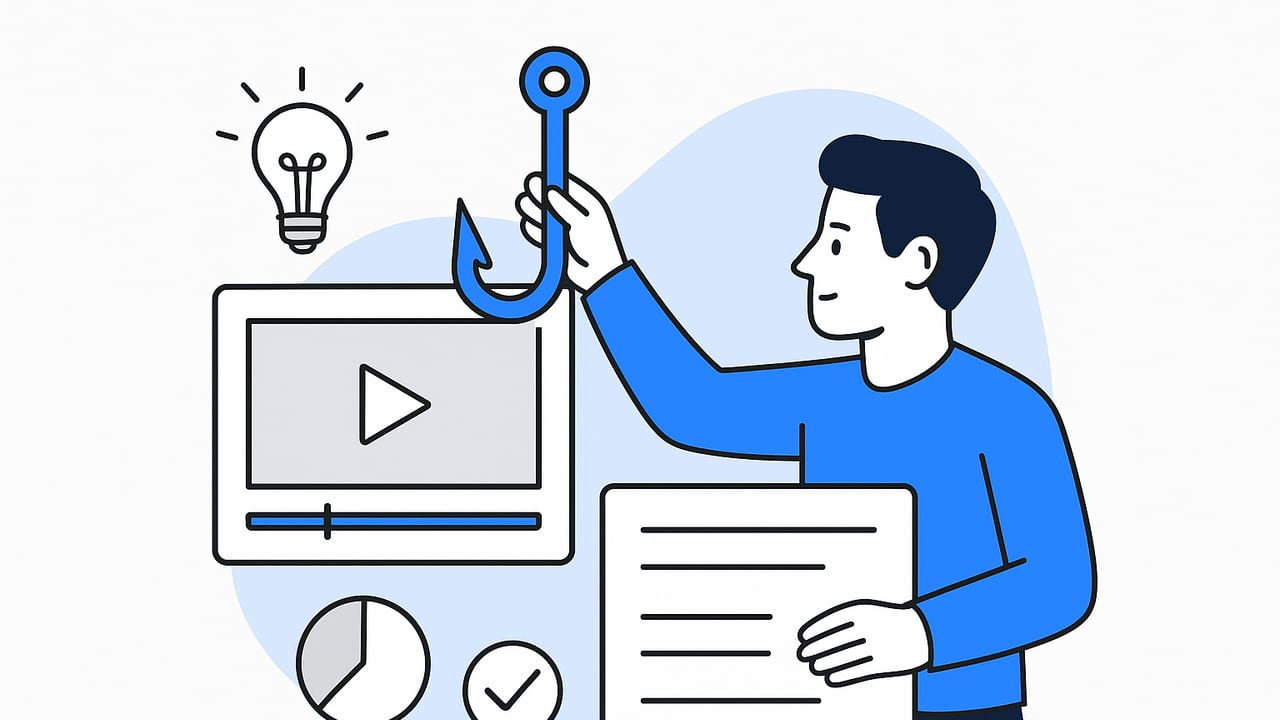
If your opening seconds don’t earn attention, the rest of your video won’t get a chance. Learning how to create a hook for a video is the difference between a scroll-by and a watch-through. Hooks are not just clever lines; they’re strategic combinations of message, motion, and proof engineered to stop the thumb, spark curiosity, and promise value fast. In this guide, you’ll learn the psychology behind hooks, platform-specific timing and formats, proven frameworks with examples, and a testing plan to improve your hook-through rate week after week.
What a Video Hook Is—and Why It Matters
A hook is the first 1–5 seconds of your video that captures attention and sets an expectation. Its job is simple: convince the viewer to invest a little more time. Effective hooks communicate who it’s for, what they’ll get, and why they should care right now. Strong hooks lift your watch time, which algorithmically improves reach. They also prime your message for retention by establishing a clear benefit or an unresolved curiosity gap. Whether you’re producing short-form social clips or long-form explainers, the best hooks combine a pattern interrupt (something visually or conceptually unexpected) with a clear promise (benefit, novelty, or emotion) and a quick proof signal (credibility, demo, or number) to reduce skepticism.
How to Create a Hook for a Video: Step-by-Step
- Define the viewer: Write a one-sentence descriptor: “This is for [role] who want [outcome] without [pain].” Your hook must call them in or call their problem out.
- Choose the angle: Pick one dominant angle per video: benefit-first, problem-first, contrarian insight, fast demo, or surprising number. Don’t cram multiple angles into the first seconds.
- Craft the promise: Finish this sentence: “In 10 seconds, you’ll know whether this can [specific outcome].” Promise clarity or a result, not vague inspiration.
- Add proof: Include a credibility cue within the hook: a visual before/after, quick stat, brand stamp, user testimonial snippet, or on-screen metric.
- Design a pattern interrupt: Use movement, jump cuts, sound hits, or an unexpected visual (e.g., start mid-action, show the end result first, or zoom on an unusual detail).
- Script the first line + on-screen text: Your first words and your first text caption should match and be readable without sound. Keep it under 12 words when possible.
- Storyboard the first three shots: Shot 1 (0–1s): striking visual + on-screen promise. Shot 2 (1–2s): hands-on demo or bold claim. Shot 3 (2–4s): proof cue.
- Record versions: Create 3–5 hook variants per video. Small changes (word choice, angle, visual) can swing retention dramatically.
Hook Timing by Platform
Different platforms “grade” your hook with different early retention checkpoints. Use these timing guidelines to decide where the hook must land.
| Platform | Critical Hook Window | Notes |
|---|---|---|
| TikTok | 0–2 seconds | Start with motion and a bold on-screen line; sound-on optional but helpful. |
| Instagram Reels | 0–2 seconds | High-contrast text and face/hand movement outperform static starts. |
| YouTube Shorts | 0–3 seconds | Curiosity + quick proof; align first line with title if used in feed. |
| YouTube (long-form) | 0–5 seconds | Promise setup, show the end state early, then rewind to how. |
| 0–3 seconds | Benefit-first with captions; social proof or authority logo helps. |
Proven Hook Frameworks (With Fill-in-the-Blank Examples)
- Problem–Agitate–Promise: “Struggling with [pain]? It’s worse because [agitation]. Here’s the 10-second fix.”
- Contrarian Insight: “Stop doing [common advice]. Do this instead: [new tactic]—here’s why it works.”
- Fast Demo First: “Watch this: [result in 2 seconds]. Now, I’ll show you exactly how.”
- Before/After Reveal: “Before: [undesirable state]. After 30 seconds: [desirable state]. Want the steps?”
- Numbered Payoff: “3 hooks that add 20% watch time—starting with the weirdest one.”
- Open Loop: “In the next 5 seconds, you’ll see why [unexpected claim]. Don’t blink.”
- Question to Avatar: “Are you a [role] who keeps [pain]? Try this once.”
- Myth Bust: “You don’t need [expensive thing] to get [outcome]. Here’s the $0 version.”
- Authority Drop: “I tested this with [metric/clients/data]. Here’s the only part that mattered.”
- Time Constraint: “Give me 15 seconds and I’ll give you [specific win].”
Pair each framework with a visual proof signal: a split-screen before/after, screen recording of metrics, hands-on product demo, or overlay of a testimonial line. Keep your on-screen text aligned with the spoken line for silent scrollers.
Copy-and-Paste Hook Templates
Use these as starting points and swap in your details:
[Role], stop scrolling. If you want [outcome] without [pain], watch this.
You’re losing [specific metric] because of [common mistake]. Fix it in 10 seconds.
Everyone does [X]. That’s why [bad result]. Do this instead: [new tactic].
Watch [result] happen in 2 seconds. Then I’ll show you the 3 steps.
Before: [state]. After: [state]. Save this for later.
I tested [tool/process] on [N cases]. Only this part moved the needle.
Visual, Audio, and Text Elements That Strengthen Hooks
- Pattern interrupts: Start mid-action, use a quick zoom-in, or reveal the “after” before the “before.” Motion in frame 1 beats a talking head at rest.
- On-screen text: Put the promise in 6–10 words, high contrast, safe margins, and center-weighted. Assume 70% of viewers watch without sound.
- Sound design: A single riser, whoosh, or bass hit can mark transitions and signal importance. Keep levels consistent and avoid loud surprises.
- Framing: Fill the screen with the subject. Faces, hands, and close-up details outperform wide shots in the first seconds.
- Thumbnails and titles (YouTube): Ensure the first line of the hook complements, not repeats, your thumbnail/title promise.
- Captions: Burned-in captions with meaningful line breaks prevent drop-off for silent viewers and reinforce your hook message.
Testing Hooks: Metrics, Experiments, and Iteration
You can’t improve what you don’t measure. Track early retention and iterate systematically.
- Hook-Through Rate (HTR): Percentage of impressions that watch past the hook window (3 seconds for Shorts/Reels/TikTok; 5 seconds for long-form). Higher HTR correlates with reach.
- 3s/5s/50% Retention: Check drop-offs at 3s, 5s, and at 50% of the video. Spikes in exits at second 1–2 indicate a weak or unclear promise.
- Thumbstop Rate (feed): Plays started divided by impressions. Low rates often mean the first frame lacks motion or contrast.
- CTR (YouTube): Thumbnail/title must set up the same promise the hook pays off.
A/B test plan:
- Create 3–5 hook variants changing only one variable: angle, first line, on-screen text, or opening shot.
- Publish variants close together to similar audiences or run paid tests with small, equal budgets for clean comparisons.
- Collect at least 500–1,000 impressions per variant. Compare HTR, 3s retention, and completion rate.
- Keep the winner, archive learnings, and roll the winning pattern into your next batch.
Iteration notes: If viewers drop at second 1, your visual lacks a pattern interrupt. If they drop at second 2–3, your promise is unclear or unbelievable. If they stay but leave by second 6–8, your delivery after the hook is too slow—cut pauses and get straight to step one.
Common Mistakes to Avoid
- Vague promises: “We’ll show you how” is weaker than “You’ll add 20% watch time with this cut.”
- Slow starts: Logos, fades, and intros belong after your hook, not before.
- Mismatch with the title/thumbnail: If your hook contradicts your packaging, viewers bounce.
- One-size-fits-all hooks: Short-form and long-form need different pacing and proof.
- No proof: Claims without a visual or data cue feel like hype.
Pre-Publish Hook Checklist
- Does the first frame move or surprise?
- Can a silent viewer grasp the promise in under 2 seconds?
- Is the hook aimed at a specific viewer and outcome?
- Is there a visual proof cue (demo, metric, before/after)?
- Is the on-screen text 6–10 words, high contrast, and center-safe?
- Does the hook pay off the title/thumbnail (YouTube) or caption (shorts)?
- Did you record at least three hook variants?
- Are there jump cuts or motion within the first 2 seconds?
- Is the transition from hook to value delivery immediate?
- Have you set success metrics (HTR, 3s/5s retention) to review after posting?
Putting It All Together
When you know how to create a hook for a video, you’ll earn more watch time, more qualified interest, and better performance across every channel. Keep your opening simple but sharp: a crisp promise, a strong visual, and a quick proof. Build a swipe file of hook lines, shoot multiple variations, and judge success by early retention, not hunches. If your content starts from product photos or stills, consider using a tool like UGCMade to accelerate motion-first openings and create scroll-stopping visuals that support your hook. The first seconds sell the next ten—make them count.