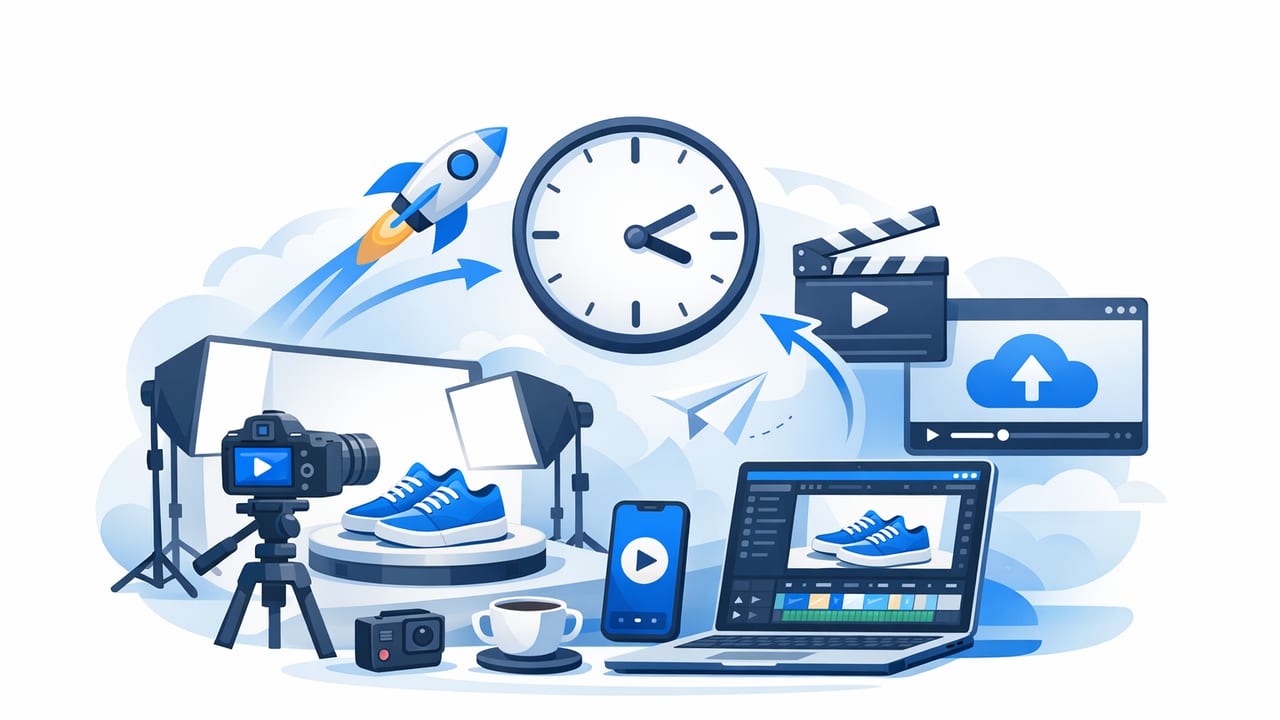
When you need a product video today—for a launch, a promotion, or a last-minute ad test—speed can’t come at the expense of brand consistency. A same day product video creation service is designed for exactly this scenario: turning existing product photography and brand assets into short, conversion-focused videos fast enough to ship within hours.
This guide breaks down how same-day production typically works, what you should prepare, realistic quality expectations, and the checks that keep “fast” from becoming “risky.” Whether you’re an ecommerce team, a performance marketer, or a brand founder, you’ll get a repeatable workflow that fits modern video marketing needs.
What “same-day” product video creation usually includes (and what it doesn’t)
Same-day delivery is most achievable when the video is built from existing product photos, a simple storyboard, and templated motion graphics—rather than fresh filming, complex 3D, or heavy compositing.
Common deliverables you can expect within 24 hours
- Short-form formats (6–30 seconds) for ads, social, and product pages
- Multiple aspect ratios (9:16, 1:1, 16:9) when requested upfront
- Basic motion: pan/zoom, kinetic text, transitions, logo end frame
- Music (licensed library track) and/or light sound effects
- On-screen copy derived from your product benefits
What usually pushes you beyond same-day
- New product filming, location shoots, or influencer/UGC casting
- Extensive rounds of revisions without a clear brief
- Missing brand assets (fonts, colors, logo rules, disclaimers)
- Unclear claims requiring legal review
Rule of thumb: Same-day works best when you’re transforming ready-to-use assets into a tight story, not inventing the story from scratch.
When a same day product video creation service makes the most sense
Fast-turn video isn’t only for emergencies. It’s a strategic advantage in any situation where you benefit from speed, iteration, and testing.
- Product launches: Get ad-ready creatives while inventory and PR momentum are hot.
- Promo windows: Flash sales, seasonal pushes, and weekend campaigns.
- Creative testing: Validate hooks and angles before investing in bigger productions.
- PDP upgrades: Add motion to your product page to increase engagement time.
- Marketplace listings: Create compliant clips that explain key features quickly.
The 24-hour workflow: from assets to export
Here’s a practical same-day workflow used by many teams doing rapid content creation and visual storytelling. The key is parallel work: while one person prepares the brief, another gathers assets and approvals.
Hour 0–1: Define the goal and the single “job” of the video
Pick one primary objective:
- Stop scroll (hook)
- Explain a benefit (clarity)
- Prove quality (trust)
- Drive action (offer)
Trying to do all four in 12 seconds usually results in none.
Hour 1–3: Asset check (the make-or-break step)
Same-day success depends on having clean inputs. Use this checklist:
- Product photos: 6–12 images minimum, 2000px+ on the long side
- Angles: hero shot, close-up detail, in-use context, packaging, variants
- Brand kit: logo (SVG/PNG), fonts, hex colors, guidelines
- Copy: 3–5 benefit bullets, one CTA, any required disclaimers
- References: 2–3 sample videos you like (pace, style, tone)
Hour 3–6: Build a micro-storyboard (even for a 10-second video)
You don’t need a full script—just a scene map. Example for a skincare product:
- Hook (0–2s): “Dry skin in winter?” + close-up texture shot
- Benefit (2–6s): “Barrier support + lasting hydration” + ingredient/detail image
- Proof (6–9s): “Derm-tested • Non-greasy” + packaging + trust badges
- CTA (9–12s): “Shop now” + hero shot + logo end frame
Hour 6–10: Edit pass 1 (structure + pacing)
This is where product photography becomes a dynamic narrative. The first pass should lock:
- Timing (seconds per frame)
- Text hierarchy (what’s readable on mobile)
- Transitions that match brand energy (minimal vs energetic)
Hour 10–14: Edit pass 2 (polish + brand alignment)
- Color and contrast consistency across photos
- Typography spacing and safe margins for 9:16
- Music cut points that match scene changes
- Logo sizing and end card duration (usually 1–2 seconds)
Hour 14–20: Review + single revision round
Same-day timelines typically allow one consolidated revision. Gather feedback in one message, prioritized by impact:
- Critical: wrong price, claim, product name, variant, or brand color
- Important: pacing, readability, scene order
- Nice-to-have: alternate transitions, optional extra shots
Hour 20–24: Export, QA, and deliver in the right specs
Export settings vary, but a common baseline for short-form video marketing:
- MP4 (H.264), 1080x1920 for 9:16
- Bitrate: 8–16 Mbps
- Frame rate: 24 or 30 fps
- Audio: AAC, 320 kbps where possible
Pricing and turnaround: what actually drives cost
Costs for same-day work vary widely, but they’re usually driven by complexity and scope rather than “minutes of video.” These are the biggest levers:
| Cost Driver | What it means | How to keep it efficient |
|---|---|---|
| Number of deliverables | More versions = more exports and QA | Start with 1 master + 2 aspect ratios |
| Motion complexity | Custom animation takes longer than templates | Use clean kinetic text + subtle movement |
| Copywriting needs | Writing from scratch adds time and review | Provide 3–5 benefit bullets + CTA |
| Compliance/legal | Claims may require review or disclaimers | Pre-approved claim library and disclaimers |
| Asset quality | Low-res photos require fixes or replacements | Provide high-res, consistent lighting shots |
Quality control: the same-day QA checklist
Fast production needs a repeatable QA process. Use this checklist before approving final files:
- Readability: Can you read every line on a phone at arm’s length?
- Brand consistency: Fonts, colors, logo placement, tone of voice
- Claim safety: No unverified “best,” “#1,” or medical claims without support
- Product accuracy: Correct variant shown (size, color, model year)
- Pacing: Hook in the first 1–2 seconds; no “dead air” frames
- Audio: Music not overpowering; no awkward cut-ins/outs
- Safe zones: Key text not covered by platform UI (especially 9:16)
- Export integrity: No compression artifacts, flicker, or cropped edges
Brief template you can copy/paste to speed up delivery
A clear brief is the fastest accelerator for same-day output. Here’s a practical template:
PROJECT: Same-day product video
PRIMARY GOAL: (Hook / Explain benefit / Prove quality / Drive action)
PLATFORMS: (TikTok, Reels, YouTube Shorts, PDP, Ads)
FORMATS NEEDED: (9:16, 1:1, 16:9)
LENGTH: (e.g., 12s, 15s, 20s)
TARGET AUDIENCE: (who + pain point)
KEY BENEFITS (3-5):
1)
2)
3)
CTA: (Shop now / Learn more / Get yours)
REQUIRED DISCLAIMERS: (if any)
BRAND ASSETS LINK: (logo, fonts, colors)
PRODUCT PHOTOS LINK: (folder)
STYLE REFERENCES: (2-3 links)
NOTES: (do/don’t, competitor callouts to avoid, pricing rules)
Making product photos look like “real video” (without filming)
Transforming product photography into video is more than a slideshow. Use these techniques to improve perceived quality:
1) Design for motion, not just images
Choose photos with depth: hands, texture, packaging angles, or context. Flat, identical shots create monotony.
2) Use “benefit-first” sequencing
Lead with the problem and outcome, then show the product. Viewers care about the result before the object.
3) Add proof elements that don’t slow pacing
- Star rating overlays (if accurate and approved)
- Short testimonial fragments
- Badges: “Free shipping,” “30-day returns,” “Cruelty-free”
4) Keep text minimal, but specific
Swap vague claims (“Amazing results”) for concrete benefits (“Reduces frizz for 24h”). Specific copy increases trust and often improves brand engagement.
Tracking performance: a simple measurement setup
Same-day content is usually made to move quickly—so measurement should be quick too. At minimum, track:
- Thumbstop rate (first 1–3 seconds)
- Hold rate (percent watched)
- CTR (if running ads)
- CVR on the landing page or PDP
If you’re linking to a product page, use UTM parameters to separate creatives. Example:
https://example.com/product?utm_source=paid_social&utm_medium=video&utm_campaign=launch&utm_content=hook_texture_15sFAQ
Can same-day videos work for premium brands?
Yes—if you prioritize clean typography, restrained motion, and consistent color grading. Premium often looks simpler, not busier.
How many revisions can you realistically do in a day?
Plan for one consolidated revision. If you expect multiple stakeholders, align approvals before production starts.
Do I need professional product photography?
High-quality photos help, but consistency matters more than perfection. Even smartphone photos can work if they’re sharp, well-lit, and stylistically cohesive.
Putting it all together
A same day product video creation service is easiest to execute when you treat the video like a focused message: one goal, one audience, one offer, backed by strong product photography and a tight storyboard. With the right brief and QA checklist, fast turnaround doesn’t have to mean disposable content—it can be a reliable way to produce repeatable creatives for ongoing testing and growth.
If you’re exploring tools that convert product photos into video quickly, platforms like UGCMade are one option to consider alongside your existing creative workflow.