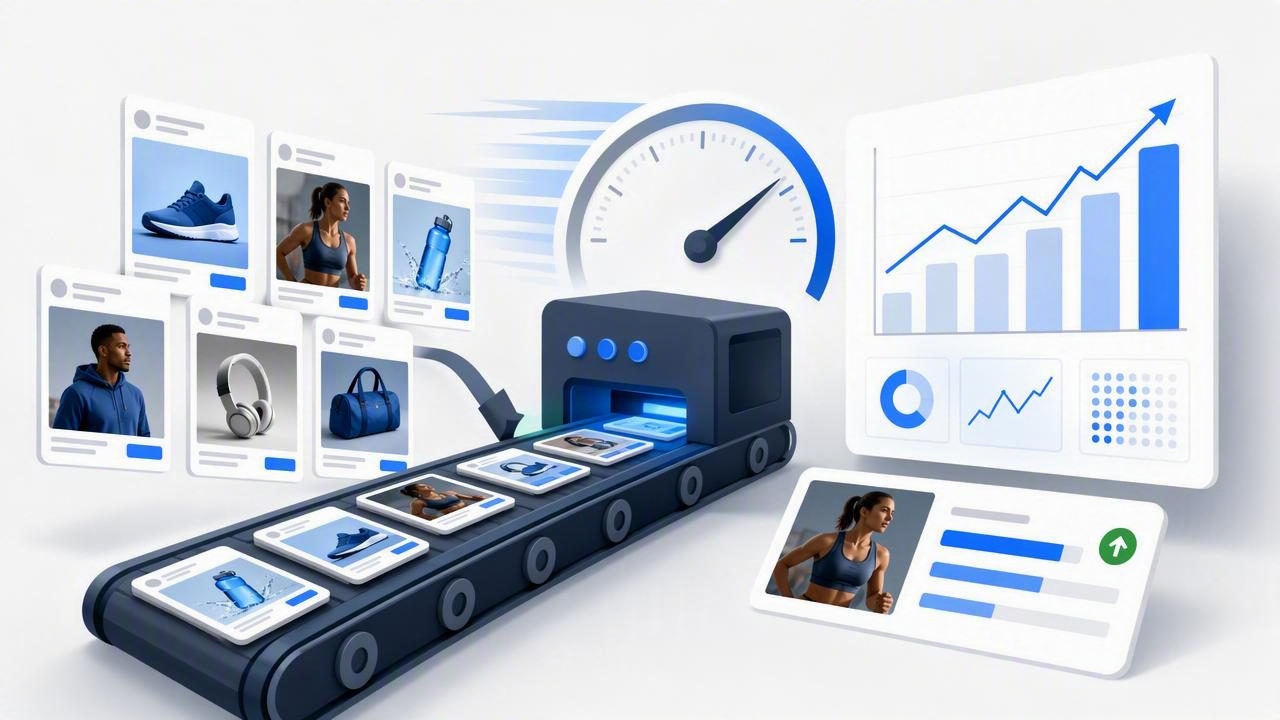
Knowing how to test more ad variations is one of the most practical advantages a marketing team can build. Paid social platforms reward relevance, audiences respond differently to the same message, and creative fatigue can quickly reduce performance. Yet many teams continue to test only a few ads at a time because producing fresh concepts feels slow, expensive, and difficult to organize.
The solution is not simply making more ads. It is creating a repeatable system that helps you produce, launch, measure, and learn from meaningful variations. When every test has a purpose, you can increase creative volume without creating confusion or wasting budget.
This guide explains how to build a scalable ad testing workflow using product photography, video marketing assets, customer insights, and clear measurement principles.
Why Testing More Ad Variations Matters
Ad platforms use signals such as engagement, watch time, clicks, conversions, and audience response to determine where and how often to show your creative. A single ad may work well for one segment but fail to connect with another. It may also perform strongly during its first week and weaken after repeated exposure.
More ad variations give you more opportunities to find the combinations that resonate. These combinations can include:
- A different opening hook or headline
- A different customer problem or desired outcome
- A new visual format, such as a short product video instead of a static image
- A different call to action
- A different offer, proof point, or product benefit
- A different audience-specific angle
Importantly, creative testing is not about guessing which design looks best. It is about learning which message, visual story, and offer move people closer to action.
Start With a Clear Testing Hypothesis
Testing a high number of ads without a plan can produce plenty of data but few useful insights. Before creating a variation, write a simple hypothesis. A strong hypothesis identifies the audience, the change you are testing, and the expected outcome.
Example: For first-time shoppers, a video that shows the product in use within the first two seconds will generate a higher click-through rate than a polished product-only image.
This statement gives your team a measurable idea to evaluate. If the test wins, you learn that demonstrating use may be more persuasive than relying on product aesthetics alone for that audience. If it loses, you have a reason to test another approach, such as social proof or a stronger value proposition.
Keep hypotheses focused. When every element changes at once, it becomes difficult to identify why an ad performed well or poorly.
Build a Creative Testing Matrix
A creative testing matrix turns a large, vague task into manageable variables. Instead of asking, “What ads should we make this month?” you can choose one option from each category and create intentional combinations.
| Variable | Examples to Test | What You Can Learn |
|---|---|---|
| Hook | Question, bold claim, problem, benefit, testimonial | Which opening earns attention |
| Visual format | Product photo, motion graphic, demo, creator-style video | Which content format drives engagement |
| Message angle | Convenience, quality, price, results, sustainability | Which value proposition connects |
| Proof | Review, statistic, before-and-after, expert quote | Which trust signal reduces hesitation |
| Call to action | Shop now, learn more, explore colors, get the offer | Which next step drives action |
You do not need to test every possible combination immediately. Select one or two priority variables per campaign. For example, you might use the same product footage and offer while testing four hooks. Once a winning hook emerges, test message angles against that hook.
Prioritize Big Creative Levers Before Small Details
Teams often spend too much time testing minor details, such as button color or a slightly different background. Those elements can matter, but they rarely create the largest performance difference in early-stage testing.
Start with high-impact creative levers:
- The first three seconds: Does the ad immediately create curiosity, identify a problem, or show a desirable result?
- The core message: Is the ad centered on a benefit that matters to the intended audience?
- The visual story: Does the content show the product, its context, and its value clearly?
- The proof: Does the ad provide a reason to believe the claim?
- The offer: Is there a compelling reason to act now?
For instance, an ecommerce brand selling a portable blender could test “smoothies anywhere,” “easy cleanup,” “morning routine upgrade,” and “protein shake in 30 seconds.” These are distinct concepts, not merely cosmetic edits. Each speaks to a different motivation.
Create Variations From One Core Asset
Fast creative testing does not require a separate production shoot for every ad. A strong set of product photography can support a wide range of video marketing and static creative variations. The key is to treat each asset as a flexible source rather than a finished, single-use deliverable.
From one product image or short clip, you can create variations by changing:
- The opening text overlay
- The crop and aspect ratio for each placement
- The sequence of product shots
- The caption or voiceover
- The background music and pacing
- The review, benefit, or feature highlighted
- The end card and call to action
For example, a skincare brand could use one clean product photo in four short videos. One version starts with “Dry skin by lunchtime?” Another opens with a customer rating. A third focuses on the ingredient story, while a fourth shows a simple morning routine. The underlying image remains the same, but the ads offer different reasons to pay attention.
Use a Modular Production Workflow
A modular workflow reduces bottlenecks and keeps your brand engagement efforts consistent. Build reusable components that can be assembled into multiple ads instead of starting from a blank canvas every time.
Useful modules to prepare
- Hook templates for common customer problems and outcomes
- Product close-ups, lifestyle shots, and detail images
- Short benefit statements approved by your brand team
- Customer reviews and testimonial excerpts
- Brand-safe fonts, colors, transitions, and end cards
- Calls to action tailored to awareness, consideration, and conversion campaigns
This structure also makes content creation easier to delegate. A strategist can supply the hypothesis and messaging angle, while a designer or video creator assembles the assets according to an established template.
Test Concepts, Then Iterate on Winners
A productive testing program has two stages: exploration and refinement. During exploration, test broad creative concepts. During refinement, improve the concepts that show promise.
In the exploration stage, you may test a product demonstration against a customer testimonial, a founder story, and a problem-solution video. After identifying the strongest format, create follow-up variations around it. Test new hooks, different proof points, shorter edits, or alternate calls to action.
This approach prevents a common mistake: optimizing an average idea for too long. If the main concept does not earn attention or generate qualified clicks, changing a line of copy may not solve the real problem.
Set Fair Testing Conditions
To get trustworthy results, keep as many variables stable as possible. If one ad runs to a warm audience and another runs to a broad audience, performance differences may be caused by targeting rather than creative.
When possible, compare variations under similar conditions:
- Use the same campaign objective and optimization event
- Run ads during the same general time period
- Use comparable budgets and placements
- Keep the landing page consistent
- Limit major audience changes during the test
Platform-native split testing tools can help, but they are not the only option. Even in a flexible campaign structure, disciplined naming conventions and consistent reporting make creative comparisons much easier.
Measure the Right Metrics for the Funnel Stage
Not every creative should be judged by purchases alone. An awareness-focused video may succeed by earning strong watch time and low-cost reach, while a retargeting ad should be evaluated more heavily on conversion efficiency.
| Campaign Goal | Useful Metrics | Creative Signal |
|---|---|---|
| Awareness | Reach, video views, watch time, thumb-stop rate | Does the opening capture attention? |
| Traffic | Click-through rate, cost per click, landing-page views | Does the message create curiosity and relevance? |
| Conversion | Conversion rate, cost per acquisition, return on ad spend | Does the ad motivate qualified action? |
Look for patterns, not just isolated winners. If multiple top-performing ads lead with customer frustrations, that is a useful insight for future messaging. If videos showing the product in context consistently outperform studio-only visuals, incorporate more real-world scenes into your creative library.
Document Learnings So Every Test Compounds
Without documentation, teams often repeat the same tests or lose valuable insights when campaigns end. Create a simple creative testing log with the hypothesis, variable tested, audience, spend, key metrics, result, and recommended next step.
A useful entry might read: “Problem-first hook outperformed feature-first hook for cold audiences, increasing click-through rate while maintaining conversion quality. Next: test three problem-first openings with different customer pain points.”
Over time, this record becomes a practical playbook for visual storytelling. It helps teams create stronger ads faster because new ideas are grounded in evidence rather than preference.
Make Creative Volume Sustainable
The best way to test more ad variations is to establish a realistic cadence. Rather than waiting for one large campaign refresh, schedule ongoing creative production. A weekly or biweekly rhythm makes it easier to respond to fatigue, seasonality, new products, and performance signals.
Start with a manageable goal, such as four to eight purposeful variations per creative theme. Use existing product photography, approved messaging, and modular templates to reduce production time. As your process becomes more efficient, increase the number of concepts you explore—not just the number of minor edits you publish.
Tools that turn product images into dynamic video assets can also help teams expand testing output while maintaining visual consistency. For brands building this kind of workflow, UGCMade can support faster experimentation from existing product photos.