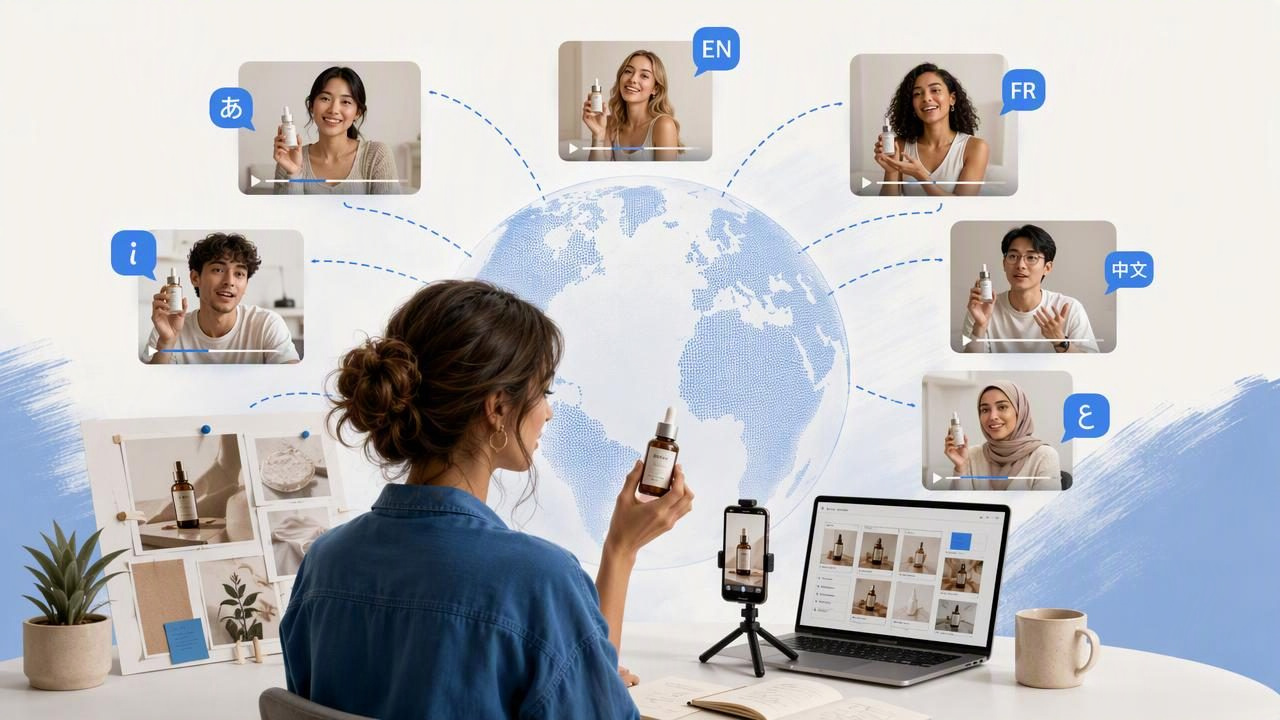
Creative agencies increasingly need to develop video concepts that work across languages, markets, and audience expectations. A single product launch may require creator-style social videos in English, Spanish, French, German, Arabic, or other languages—without losing the original campaign message. This creates a practical challenge: how can an agency explore multilingual UGC-style creative efficiently while keeping the product, tone, claims, and visual identity consistent?
A multilingual UGC generator can support the planning and comparison stage of this work by helping teams turn a product image into multiple video concept directions. The goal is not to assume that one translated script will perform equally everywhere. Instead, agencies can use AI-generated UGC-style concepts to identify which hooks, product demonstrations, visual cues, and calls to action deserve further localization and production attention.
This guide explains how to prepare multilingual creative concepts from a product image, compare variations responsibly, and recognize the limitations of AI-generated video in agency workflows.
Why Multilingual UGC-Style Video Needs a Different Creative Process
Traditional translation is rarely enough for short-form video marketing. A phrase that feels conversational in one language can sound overly formal, vague, or unnatural in another. The same applies to humor, product benefits, lifestyle settings, beauty routines, visual gestures, and on-screen text.
For creative agencies, multilingual content creation involves more than changing subtitles. It requires aligning four elements:
- Core campaign message: The primary product benefit or customer problem should remain accurate across concepts.
- Local language patterns: Hooks should match how people actually speak and discover products in that market.
- Visual storytelling: A product image, opening frame, setting, and product demonstration must make sense for the intended audience.
- Brand and compliance review: Product claims, regulated categories, disclosures, and cultural references require human oversight.
UGC-style video is designed to feel personal and direct. That makes awkward wording more noticeable. If a creator-style concept sounds translated rather than naturally spoken, audiences may disengage before the product message is clear.
Start With a Product Image That Can Support Multiple Markets
A strong product photo gives your team a stable visual reference before any video concept is created. It helps maintain consistency when comparing different hooks, languages, and creative directions. The image does not need to contain every campaign detail, but it should make the product easy to identify.
What to look for in the source image
- A clear, well-lit product with visible packaging, texture, or important details.
- A background that does not distract from the item or conflict with the intended campaign mood.
- Readable labels if packaging recognition is important to the concept.
- No misleading visual additions, such as unverified results or product features that are not shown.
- Enough visual flexibility to support close-ups, lifestyle framing, or a product demonstration idea.
For example, imagine an agency is preparing concepts for a reusable insulated water bottle. The source image shows the bottle upright on a clean kitchen counter, with the cap, handle, and logo clearly visible. That image can anchor several UGC-style directions, including a morning routine, gym bag packing moment, desk hydration reminder, or travel packing scenario.
The image remains the same product reference, but the surrounding story can change by audience and language.
Build a Creative Brief Before Generating Language Variations
Agencies should define what must stay consistent before exploring multilingual versions. This reduces the risk of comparing concepts that differ in too many ways at once. A clear brief also makes internal review faster for strategists, copywriters, brand managers, and local market teams.
| Brief Element | Example for a Water Bottle Campaign | Why It Matters |
|---|---|---|
| Product truth | Reusable insulated bottle with a carry handle | Prevents invented features or unsupported claims |
| Primary audience | Busy commuters and gym-goers | Shapes the setting and everyday use case |
| Core message | Keep a reusable bottle close during a busy day | Creates consistency across languages |
| Desired tone | Practical, energetic, conversational | Guides creator-style delivery |
| Restricted claims | No temperature-duration or health claims | Supports brand and legal review |
| Localization notes | Use natural regional wording for “water bottle” | Avoids literal translations |
Keep this brief short enough that every stakeholder can use it. A useful rule is to distinguish between non-negotiables and localizable elements. The product, approved claim boundaries, and logo treatment may be fixed. The opening phrase, setting, idiom, pacing, and call to action may need adaptation.
A Concrete Example: Comparing Three Language Concepts
Suppose the agency wants to explore an awareness-stage campaign for the reusable bottle. Rather than producing one generic video and translating it word for word, the team can create three concept briefs that retain the same product truth.
Concept 1: English—Busy Morning Reminder
Hook: “The one thing I always forget before leaving the house?”
Story: A creator-style scene shows a rushed morning routine, followed by the bottle being picked up from the counter and placed in a bag.
Product focus: The carry handle and repeatable daily habit.
On-screen text direction: “Keys. Phone. Water.”
Concept 2: Spanish—Daily Routine and Convenience
Hook direction: A conversational opening about leaving home prepared for a long day.
Story: The bottle appears alongside everyday essentials before a commute or class.
Product focus: Keeping the bottle nearby as part of a daily routine.
Localization note: The copywriter should choose wording based on the intended Spanish-speaking market rather than treating Spanish as a single uniform audience.
Concept 3: French—Desk-to-Commute Lifestyle Moment
Hook direction: A quick observation about staying organized between work, errands, and travel.
Story: The bottle is shown on a desk, then carried out the door.
Product focus: A reusable object that fits into a mobile day.
Localization note: Keep the tone concise and natural rather than forcing an English-style rhetorical question.
These are creative examples, not evidence that the concepts will produce a particular business outcome. They show how an agency can compare ideas while preserving a consistent product image and campaign objective.
Use a Comparison Framework Instead of Judging by “Vibes”
When reviewing AI-generated UGC-style video concepts, agencies need an evaluation method that goes beyond whether a video looks polished. The best concept for a market is not always the most visually dramatic one. It is the one that communicates the product clearly, fits the audience context, and can be safely developed into final creative.
Review each concept against the following criteria:
- Product clarity: Can viewers identify the product and its relevant visible features quickly?
- Hook relevance: Does the opening reflect a recognizable local need, routine, or frustration?
- Language naturalness: Would a native speaker use this phrasing in casual short-form content?
- Visual-cultural fit: Does the environment, gesture, styling, and pacing feel appropriate for the intended market?
- Brand fit: Does the concept match the approved brand voice and visual standards?
- Claim safety: Does it avoid making promises the product information does not support?
- Testability: Is the main variable clear enough to compare with another version?
A simple scoring worksheet can help teams document why a concept moves forward:
Concept: Spanish daily routine
Product clarity: 4/5
Language naturalness: Needs native review
Brand fit: 5/5
Claim safety: Approved with no added claims
Test variable: Routine-based hook vs. commute-based hook
Decision: Revise opening line, then prepare for local review
This approach makes creative feedback more actionable. Instead of saying “the Spanish version does not feel right,” reviewers can identify whether the issue is the phrase, pacing, visual context, or product demonstration.
Separate Concept Exploration From Final Market-Ready Content
AI-generated UGC-style video concepts can be useful for ideation, creative briefing, and early comparison. They should not automatically be treated as finalized advertising assets. Agencies should establish a review stage before publishing or using content in paid campaigns.
Human review is particularly important for:
- Grammar, idioms, pronunciation, and regional vocabulary.
- Legal and regulatory requirements for product claims.
- Required disclosures, captions, or accessibility standards.
- Cultural sensitivity and the suitability of imagery for a local market.
- Brand safety, trademark use, and approval of final copy.
A multilingual generator may help a team visualize a direction, but it cannot replace a local strategist, native-language copywriter, or legal reviewer. This is especially true for health, finance, food, children’s products, alcohol, cosmetics, and other categories with stricter messaging expectations.
Practical principle: Use AI-generated concepts to make better creative decisions earlier—not to remove the need for informed local review.
Common Mistakes Creative Agencies Should Avoid
Translating a winning concept literally
A strong English hook may depend on phrasing, humor, or a cultural reference that does not travel. Preserve the underlying audience insight, then rewrite the expression for the local context.
Changing every variable at once
If the language, actor style, setting, hook, product angle, and call to action all change, the team cannot tell what created the difference. Keep a stable product image and campaign goal while testing one or two meaningful creative variables.
Assuming one language equals one market
French, Spanish, Arabic, Portuguese, and English all include regional variation. Define the actual market, audience segment, and platform context before approving language.
Adding claims during localization
A translator or concept writer may unintentionally make a product benefit sound stronger. Give every market team a list of approved wording and prohibited claims.
Make Multilingual Creative Planning More Repeatable
To scale this process, agencies can create a reusable concept matrix. Start with one product image, one approved product truth, and three or four audience insights. Then adapt the insight—not merely the words—for each target market.
For teams turning product photography into early video directions, UGCMade’s guide to moving from a product photo to video concepts offers useful context for structuring the visual starting point.
The strongest multilingual UGC-style strategy combines efficient concept exploration with rigorous local judgment. When agencies treat AI video as a creative comparison tool, they can develop more relevant visual storytelling, protect brand consistency, and give each market a version of the message that feels considered rather than copied.