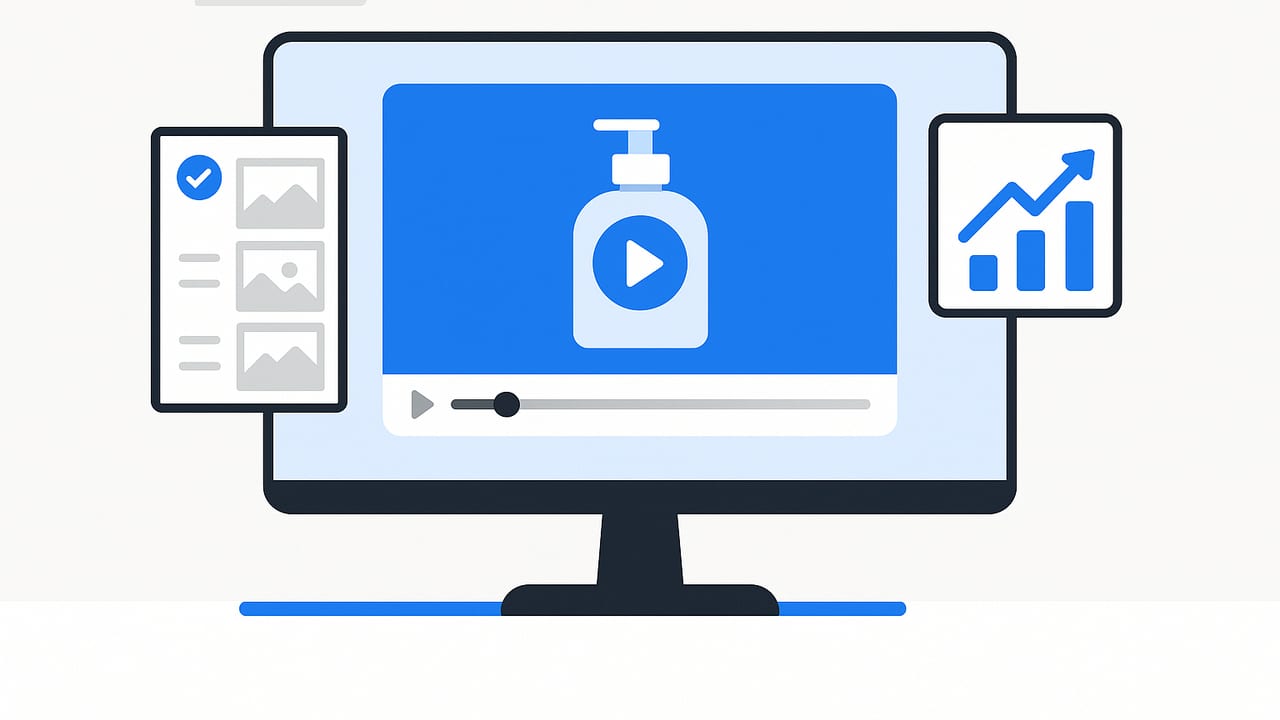
Product promo videos are one of the fastest ways to turn attention into action. Whether you sell on your own site, marketplaces, or social, the right promo can showcase value, remove objections, and trigger a click in seconds. This guide covers strategy, formats, script frameworks, platform specs, and the key metrics that make product promo videos perform.
What Exactly Is a Product Promo Video?
Think of a product promo video as a focused, conversion-minded creative. It highlights a product’s value proposition, demonstrates benefits, and pushes a clear action—usually a product page visit, add to cart, or purchase. It’s different from:
- Explainers: Teach concepts or brand stories; longer and more educational.
- Demos: Deep walkthroughs; higher detail, less urgency.
- UGC testimonials: Social proof first, product second; great as a promo format, too.
The best promos blend all three: a clear promise, a quick proof, and a strong prompt to act.
Build a Strategy Before You Hit Record
A tight strategy prevents random creative and wasted media spend. Use this five-part brief:
- Audience: Who’s the viewer? Name one segment, one pain point, one desired outcome.
- Offer: What’s the most compelling reason to act now (benefit, bundle, guarantee, or limited-time incentive)?
- Channel: Where will it run (Reels, TikTok, Shorts, feed, PDP, email)? Match aspect ratio, length, and vibe.
- Angle: Choose a message frame: problem-solution, comparison, transformation, or social proof.
- Action: What should happen next—click, claim, subscribe? Say it plainly and on-screen.
Winning Formats for Product Promo Videos
Rotate formats to avoid creative fatigue and to match different shopper intents:
- Problem → Solution: Show a relatable pain, then a single decisive fix.
- Feature → Benefit Carousel: Rapid cuts with on-screen text: Feature, why it matters, micro-proof.
- Before/After: Visual transformation; ideal for beauty, home, and gadgets.
- Unboxing + First Use: Packaging, setup, payoff—in under 20 seconds.
- UGC-Style Testimonial: Front-camera “I tried it so you don’t have to,” with quick B-roll inserts.
- Comparison: Your product vs. status quo or competitor—focus on one decisive difference.
- Offer Spotlight: Bundle, seasonal discount, or free shipping with urgency and clear terms.
- FAQ Bust: Address top objections (durability, sizing, returns) with visual proof.
- Motion from Stills: Turn product photos into dynamic cuts with parallax, text overlays, and sound.
Story Structures That Sell
Keep structure simple and repeatable. These frameworks map to 6–30 second promos:
- AIDA: Attention → Interest → Desire → Action. Classic and versatile.
- PAS: Problem → Agitate → Solution. Great for everyday pain points.
- 3x3: Hook (0–3s) → Value (3–9s) → Proof + CTA (9–15s). Ideal for social ads.
- 5-Beat: Hook → Problem → Solution → Proof → CTA. For 20–30 seconds with room for social proof.
Sample 15-Second Promo Outline (3x3)
- 0–3s: Hook with a pattern interrupt and a bold claim on-screen.
- 3–9s: One or two benefits with quick product B-roll and pop-up captions.
- 9–15s: Proof (testimonial, demo, or rating) and a clear CTA on-screen and in voiceover.
Shot List and Script Template
Use this as a starting point; trim or expand per channel and offer.
| Beat | Suggested Visual | On-Screen Text / VO | Duration |
|---|---|---|---|
| Hook | Close-up + motion; quick problem visual | “Stop wasting time on X. Try this instead.” | 0–3s |
| Problem | Relatable scene showing friction | “X is messy, slow, and pricey.” | 3–5s |
| Solution | Product in action; tactile close-ups | “[Product] fixes it in 10 seconds.” | 5–8s |
| Proof | Before/after or rating overlay | “2,000+ happy reviews. 30-day guarantee.” | 8–12s |
| CTA | Packshot + offer badge | “Tap to try it risk-free.” | 12–15s |
Fill-in Script Template
[HOOK] If you struggle with <problem>, this <product type> changes everything.
[PROBLEM] <Problem in a sentence>—it’s <pain adjective> and <pain adjective>.
[SOLUTION] <Product name> does <benefit> in <timeframe>.
[PROOF] <Short testimonial or stat> + <visual proof>.
[CTA] Get <offer>. Tap to <action>.
Hooks That Earn the First Three Seconds
Test multiple hooks on the same body to find your winners:
- “This fixes [pain] in under 10 seconds.”
- “I replaced [old solution] with this.”
- “Three mistakes you’re making with [category].”
- “POV: You hate [pain], try this.”
- “Don’t buy [competitor] until you see this.”
- “If you have [trait], you need this.”
- “I wish I knew this sooner about [category].”
- “I tested the top 3 so you don’t have to.”
- “This one tweak saves me $/time every week.”
- “The simplest way to get [desired outcome].”
Platform Specs and Best Practices
Platform limits evolve, but these guidelines keep product promo videos native and watchable. Always verify current ad specs before launch.
| Platform | Aspect Ratio | Recommended Length | Notes |
|---|---|---|---|
| TikTok | 9:16 | 6–20s for ads; up to 30s organic | Bold hooks, captions on-screen, safe text zones |
| Instagram Reels | 9:16 | 6–20s for promos | Use native text styles and trending sounds when suitable |
| YouTube Shorts | 9:16 | 10–30s | High-contrast captions, audible VO or music |
| Facebook Feed | 1:1 or 4:5 | 6–15s | Add subtitles; avoid tiny text |
| 9:16 or 2:3 | 6–20s | Emphasize visuals over VO | |
| Product Pages (PDP) | 16:9, 1:1, or 9:16 | 15–45s | Detail over speed; show use cases and close-ups |
Clarity beats cleverness. Say the benefit in words the shopper already uses.
Creative Testing and the Metrics That Matter
Don’t guess—test hooks, angles, and offers. Keep one variable per test when possible.
| Metric | What It Tells You | How to Improve |
|---|---|---|
| Thumbstop/Hook Rate (e.g., 2–3s view) | Did the first seconds earn attention? | Stronger hook, tighter framing, faster motion, bigger text |
| Hold Rate (25/50/75%) | Is the story rewarding continued viewing? | Faster cuts, reveal sequencing, remove filler |
| CTR / Tap-Through | Does the value proposition trigger action? | Sharper CTA, clearer offer, benefit-first captions |
| CPA / ROAS | Is it profitable traffic? | Audience refinement, landing page alignment, price/offer tweaks |
| Scroll-Back or Rewatches | Relevance and intrigue | Tease outcomes, add micro-mystery, show transformations |
A Simple Creative Test Plan
- Create 1 “body” video (middle and end) with 5 different hooks.
- Run small-budget splits to isolate a winning hook.
- Swap angles: problem-solution vs. social proof vs. comparison.
- Iterate the winner with offer variants (bundle, guarantee, limited-time).
Production Tips That Lift Performance
- Light and contrast: Use a key light and avoid mixed color temperatures.
- Framing: Fill the frame with the product; keep text in safe zones.
- Motion: Add micro-movement—pan, tilt, parallax, or handheld energy.
- Sound: Prioritize clean voiceover; add subtitles for silent viewers.
- Text hierarchy: One idea per screen; 4–7 words per caption for readability.
- Brand cues: Logo minimally, color accents consistently; avoid clutter.
- Compliance: Avoid unverified claims; disclose offers clearly.
- Accessibility: High contrast, legible fonts, and accurate captions.
Turning Product Photos into Effective Promo Videos
No live footage? You can still build high-performing product promo videos from stills:
- Curate assets: Hero, lifestyle, detail, and context shots at high resolution.
- Sequence: Hook photo → benefit photo → detail → social proof → packshot + CTA.
- Motion: Use Ken Burns (zoom/pan), parallax layers, and masked reveals to add depth.
- Overlay: Benefit-first captions, offer badges, and rating screenshots as proof.
- Sound design: Snappy SFX on cuts; music that matches energy and audience.
- VO or text-to-speech: Short lines, natural pacing, avoid robotic cadence.
Photos-to-video workflows shine for catalogs, PDP loops, quick ad iterations, and seasonal offers.
A Lightweight Workflow You Can Reuse
Pre-Production
- Define one audience, one promise, one CTA.
- Draft a 15-second script with the 3x3 framework.
- Build a shot list and gather assets (photos, B-roll, testimonials).
Production
- Capture or transform assets; record VO after timing the edit.
- Design captions for mobile readability; keep elements large and centered.
Post-Production
- Export multiple hooks and aspect ratios.
- Add subtitles, audit audio levels, confirm safe zones.
- QA for claims, pricing, and URLs.
Launch and Learn
- Start with hook testing; scale winners into new angles.
- Refresh creatives every 1–2 weeks to fight fatigue.
- Feed learnings back into scripts and shot lists.
Example Creative Brief (Fill-and-Run)
Product: <Name / Category>
Audience: <Segment> who want <outcome> without <pain>
Angle: Problem → Solution with quick social proof
Hook Ideas:
  1) “Fix <pain> in 10 seconds.”
  2) “I stopped using <old solution> because…”
  3) “Three reasons this <product> is worth it.”
Offer: <Bundle / Discount / Guarantee>
CTA: Tap to try it risk-free
Assets: 6 photos (hero, lifestyle, detail x2, before/after), 1 rating screenshot
Length: 15s (9:16)
Notes: Big captions, loud first second, safe zones respected
Common Mistakes to Avoid
- Feature dumping: Translate features into outcomes; lead with the benefit.
- Buried CTAs: Place the CTA verbally and visually; repeat near the end.
- Slow starts: Start with motion and a visible benefit; no logos in second one.
- Overlong edits: Trim to the shortest version that still makes the point.
- Inconsistent style: Maintain brand colors, font, and tone across promos.
From Insight to Impact
Great product promo videos are a system, not a one-off. When you combine a clear promise, tight structure, and disciplined testing, you build a repeatable engine for discovery, clicks, and conversions. Start small: ship one 15-second promo with three hooks this week, review the data, and iterate. The cadence—create, test, learn, refresh—will compound faster than any single “perfect” edit.
If you’re starting from product photos and want to accelerate production, a tool like UGCMade can transform static images into on-brand, AI-powered promo videos with motion, captions, and sound—handy for fast iterations across channels.