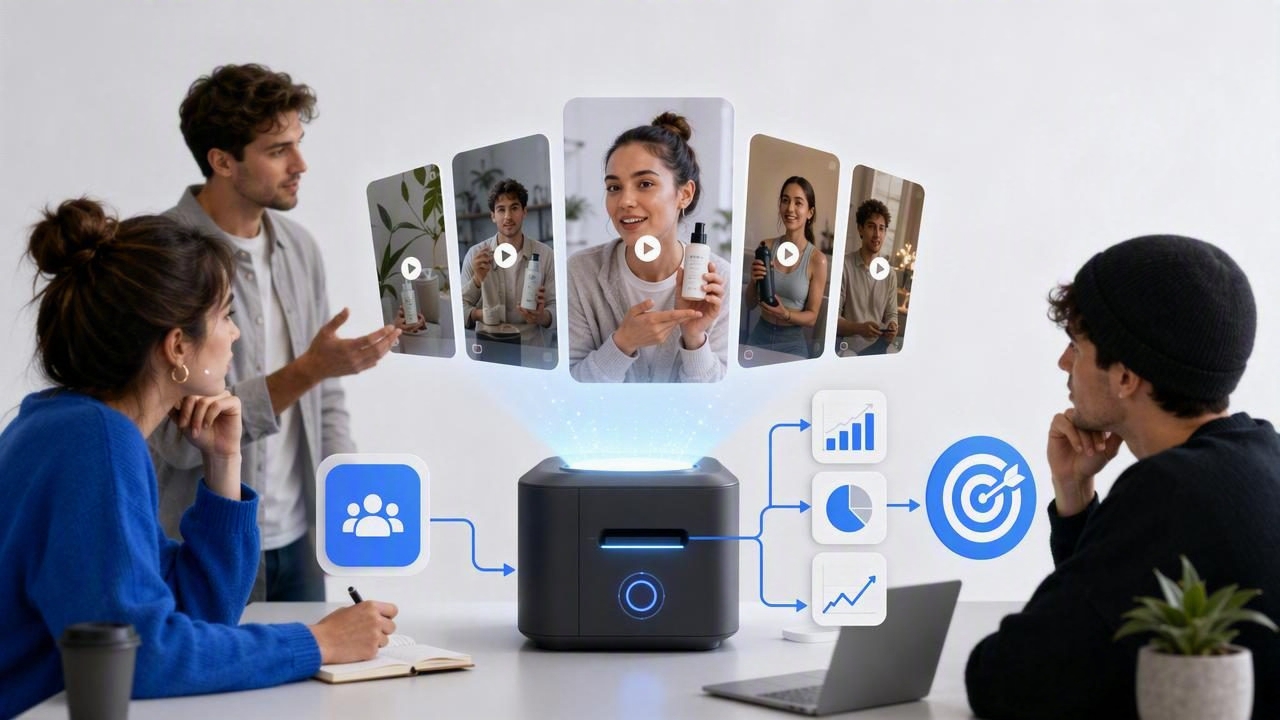
Creative agencies are under growing pressure to produce more content, more quickly, without compromising quality. Clients expect a constant stream of paid social ads, organic videos, product launches, seasonal promotions, creator-style assets, and campaign variations. At the same time, audiences have become highly selective about what earns their attention.
A UGC creative generator for creative agencies can help bridge the gap between high-volume content demands and limited production resources. Rather than replacing creative strategy or human storytelling, these tools can help teams turn existing product photography, scripts, brand assets, and campaign messages into video concepts that feel native to social platforms.
This guide explains how agencies can use UGC-style creative generation effectively, where it fits in a modern content workflow, and how to maintain brand quality while scaling production.
What Is a UGC Creative Generator?
A UGC creative generator is a tool or platform designed to help marketers create user-generated content-style ads at scale. UGC-style content typically resembles the videos consumers encounter in their everyday feeds: a person speaking directly to the camera, a product demonstration, a testimonial, an unboxing sequence, a problem-and-solution story, or short lifestyle footage paired with text overlays.
For agencies, the generator may support a range of inputs, including:
- Product photos and packaging images
- Brand messaging and campaign briefs
- Creative scripts and hooks
- Customer reviews and testimonials
- Product features, pricing, and promotional details
- Video templates, voiceovers, captions, and calls to action
The objective is not simply to make more videos. It is to make more testable creative angles that are tailored to the pacing, format, and expectations of channels such as TikTok, Instagram Reels, YouTube Shorts, and paid social placements.
Why Creative Agencies Need Scalable UGC-Style Production
Traditional video production remains valuable for brand films, launch campaigns, and premium storytelling. However, it can be expensive and time-consuming when a client needs 30 variations of a performance ad. Agencies often need to balance polished hero assets with faster, more iterative content designed for testing.
UGC-style video fills that operational gap. It allows agencies to produce content that feels immediate, relatable, and platform-native while using a more flexible workflow.
| Creative Need | Traditional Production | UGC-Style Generation |
|---|---|---|
| Hero brand campaign | Best suited for high-production storytelling | Useful as supporting social content |
| Weekly ad testing | Can be slow and resource-heavy | Well suited for rapid variations |
| Product feature updates | May require reshoots and editing cycles | Can adapt existing assets quickly |
| Localized messaging | Often increases production complexity | Supports scalable copy and format changes |
| Creative experimentation | Higher cost per concept | Lower barrier to testing new angles |
For an agency managing multiple clients, this efficiency can be especially useful. A team can reserve custom shoots for moments where they matter most, then use a streamlined content creation system to keep the campaign calendar full between major productions.
The Core Benefits for Agency Teams
1. More Creative Variations From One Brief
A single client brief can contain many potential messages. A skincare brand, for example, may have a hydration story, a sensitive-skin story, a quick-routine story, an ingredient story, and a social-proof story. Creating each angle through a full production process can be difficult.
With a structured creative generator workflow, the agency can develop multiple versions of the same core concept. The visual structure may stay consistent while the opening hook, product benefit, voiceover, caption, and CTA change.
2. Faster Testing for Performance Campaigns
Performance marketing depends on learning. Agencies need to understand which opening lines stop the scroll, which product benefits resonate, and which visual formats encourage clicks or conversions. The fastest way to learn is to test a focused set of meaningful variations.
Instead of producing random versions, test one major variable at a time:
- Hook: question versus bold statement
- Angle: convenience versus results versus affordability
- Format: product demo versus testimonial
- CTA: shop now versus learn more versus limited-time offer
- Length: 10-second, 15-second, and 30-second versions
This approach gives creative and media teams clearer feedback on why an asset performed well.
3. Better Use of Existing Product Photography
Many clients already have a library of ecommerce images, lifestyle photos, packaging shots, and product details. These assets are often underused because static images alone may not achieve the engagement of short-form video.
Agencies can transform approved product photography into dynamic visual storytelling by adding movement, scene sequencing, on-screen copy, voiceover, animated details, and product-focused transitions. This makes existing creative investments work harder without requiring a new shoot for every campaign need.
4. Improved Capacity Without Sacrificing Strategy
The strongest agency value is not the ability to click buttons in an editing tool. It is strategic thinking: understanding the audience, identifying the right message, protecting the brand, and interpreting performance data. Automation and creative generation can reduce repetitive production tasks so teams can spend more time on those high-value activities.
How to Build an Agency Workflow Around UGC Creative Generation
Successful scaling requires more than access to a tool. It requires a repeatable process that keeps creative output aligned with client goals.
- Start with a clear campaign objective. Define whether the goal is awareness, email signups, product discovery, lead generation, or direct sales. The objective should shape the hook, pacing, proof points, and CTA.
- Create a message matrix. List the audience pain points, product benefits, objections, offers, and proof elements. This becomes the foundation for distinct creative angles.
- Develop a hook library. Write multiple opening lines for each angle. The first two seconds are critical in short-form video, so hooks deserve focused iteration.
- Choose visual inputs. Select product photos, lifestyle images, creator footage, review snippets, logos, and approved brand elements.
- Produce batches, not isolated assets. Create a set of variations from each concept rather than requesting one video at a time. Batch production improves consistency and makes testing easier.
- Review for brand safety and accuracy. Confirm that claims are substantiated, product details are correct, captions are readable, and visual treatments match the client’s guidelines.
- Launch, measure, and iterate. Use media results and qualitative feedback to determine which concepts deserve additional versions.
A Simple Creative Brief Template
Before generating a UGC-style video, give every team member or production system a concise brief. Consistent inputs create more consistent outputs.
Campaign goal: Drive first-time purchases
Audience: Busy professionals aged 25–40
Product benefit: Saves time during a daily routine
Primary angle: "My five-minute fix"
Hook: "I stopped wasting time on this every morning."
Proof: Product demonstration + customer rating
CTA: "See how it works"
Format: Vertical 9:16, 15 seconds, captions on
Brand rules: Use approved colors; avoid unsupported claims
This type of brief gives the team enough direction to produce creative quickly while preserving room for experimentation.
Best UGC Video Formats for Client Campaigns
Not every UGC-style asset should look the same. A creative agency can build a more resilient content pipeline by using several repeatable formats.
- Problem-solution videos: Start with a relatable frustration, then show how the product addresses it.
- Product demonstration videos: Show the product in use, especially when the result is visual or immediate.
- Testimonial-style videos: Use reviews, creator narration, or customer quotes to establish credibility.
- Before-and-after stories: Useful for organization, beauty, home, fitness, and transformation-focused categories when claims are compliant.
- Listicle videos: Frame product benefits as “three reasons,” “what I noticed,” or “what surprised me.”
- Founder or expert-led videos: Add authority by explaining product design, ingredients, methods, or use cases.
Effective UGC-style creative does not imitate authenticity superficially. It earns attention by making a specific, useful, believable point quickly.
Common Mistakes to Avoid
Scaling content can create problems when volume becomes the only goal. Agencies should watch for these common mistakes:
- Using generic scripts: Broad statements such as “This changed everything” may sound familiar but rarely communicate a compelling reason to care.
- Ignoring the first seconds: An attractive product shot is not always a strong hook. Lead with tension, curiosity, a result, or a clear audience problem.
- Creating too many minor variations: Changing a caption color is less informative than testing an entirely different customer motivation.
- Forgetting platform context: A polished horizontal commercial should not simply be cropped into a vertical social ad. Adapt pacing, framing, and text placement.
- Overlooking compliance: Regulated categories, promotional language, endorsements, and product claims require a defined approval process.
How to Measure UGC Creative Performance
The right KPIs depend on campaign objectives, but agencies should connect creative performance to business outcomes whenever possible. For awareness content, assess reach, video completion rate, and engaged views. For direct-response campaigns, prioritize click-through rate, landing-page views, cost per acquisition, conversion rate, and return on ad spend.
Also review the creative signals behind the numbers. Did viewers respond to a certain hook? Did a product demonstration outperform a testimonial? Did shorter videos produce more completed views but fewer purchases? These insights can guide the next production cycle.
Turning Creative Volume Into Better Client Results
A UGC creative generator for creative agencies is most effective when it supports a disciplined creative strategy. The goal is not to flood channels with interchangeable videos. It is to create a reliable system for translating campaign insights into fresh visual storytelling.
By combining product photography, clear messaging, structured testing, and thoughtful brand review, agencies can create content that is both scalable and distinctive. Platforms such as UGCMade can support this workflow by helping teams turn product visuals into engaging video assets more efficiently, leaving more time for the strategy and creative direction clients value most.