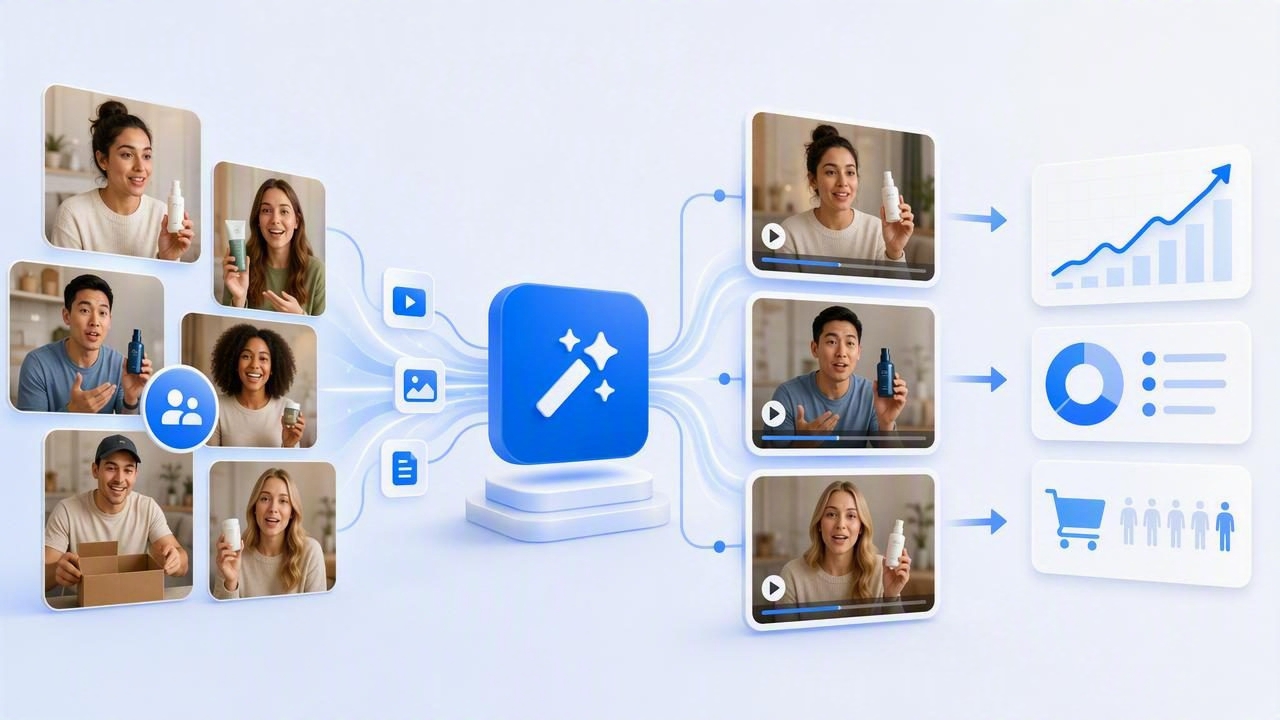
Paid social teams face a persistent challenge: audiences tire of ads quickly, while advertising platforms reward fresh, relevant creative. Producing enough concepts, hooks, formats, and variations through a traditional shoot-and-edit process can be expensive and slow. A UGC creative generator for faster ad production helps marketers turn approved product visuals and messaging into a broader range of user-generated-content-style videos without rebuilding every asset from scratch.
The goal is not simply to make more ads. It is to create a repeatable system for producing videos that feel native to social feeds, communicate a clear product benefit, and give media buyers meaningful variables to test. When creative production becomes more efficient, brands can respond faster to performance data, seasonal opportunities, inventory changes, and platform trends.
Why Faster Ad Production Matters in Performance Marketing
Creative is one of the most important levers in paid advertising. Even a well-targeted campaign can lose momentum when the visuals, opening message, or offer feel repetitive. Ad fatigue can lead to lower click-through rates, rising acquisition costs, and reduced engagement over time.
Traditional production often creates a bottleneck. A new campaign may require product samples, creator sourcing, contracts, shipping, filming, revisions, editing, captions, approvals, and exports. That process can be appropriate for major brand campaigns, but it is not always practical for testing dozens of short-form concepts.
A UGC-style creative workflow makes it easier to separate what needs high-touch production from what can be efficiently adapted. Product photography, customer insights, product descriptions, reviews, and brand guidelines become reusable inputs for new video variations.
What Is a UGC Creative Generator?
A UGC creative generator is a tool or workflow that helps create short-form, user-generated-content-inspired advertising assets from existing brand materials. Depending on the platform, it may combine product photos, video clips, scripts, voiceovers, captions, motion effects, and templates into ready-to-test video ads.
UGC-style does not necessarily mean content was made by an actual customer. It describes a creative approach: conversational language, relatable scenarios, direct demonstrations, informal framing, social-proof cues, and a mobile-first presentation. Brands should always use accurate disclosures and avoid implying that fictional reviews, testimonials, or creators are real.
Core inputs for scalable creative production
- Product photography: Clean packshots, lifestyle images, close-up detail shots, and before-and-after visuals.
- Product information: Features, benefits, use cases, ingredients, specifications, and objections.
- Audience insights: Pain points, motivations, search terms, frequently asked questions, and reviews.
- Brand guardrails: Approved claims, tone of voice, visual standards, and restricted language.
- Ad requirements: Placement dimensions, duration, CTA, offer details, and destination URL.
The Building Blocks of High-Performing UGC-Style Ads
Fast production only matters if the resulting ads are clear and compelling. The best UGC-style video ads usually follow a straightforward structure that matches how people consume content in a feed.
| Ad Element | Purpose | Example |
|---|---|---|
| Hook | Stops the scroll in the first few seconds. | “I stopped buying three separate products after finding this.” |
| Problem | Creates relevance and audience recognition. | “My desk was always cluttered and impossible to clean.” |
| Demo | Shows how the product works or looks in context. | A quick sequence of setup, use, and result. |
| Proof | Builds confidence with factual support. | Rating, verified review excerpt, or product detail. |
| CTA | Gives viewers a clear next action. | “Choose your color and see the full collection.” |
For most short-form placements, keep the product visible early. A beautiful introductory montage may work for brand awareness, but direct-response creative often benefits from showing the item and its value proposition almost immediately.
A Practical Workflow for Faster Ad Production
Speed comes from a documented process, not from rushing through creative decisions. The following workflow helps teams create consistent, testable ads while protecting brand quality.
1. Build a reusable asset library
Organize product imagery and messaging before launching a creative sprint. Label assets by product, angle, audience, season, orientation, and usage rights. Include multiple image types: hero shots, product-in-hand photos, detail images, application steps, and lifestyle contexts.
Strong source visuals make a significant difference. Product photos should have adequate resolution, clear lighting, and enough negative space for text overlays where needed. If an image will be animated, ensure the product edges are distinct and key details are not obscured.
2. Turn customer language into creative angles
Review customer reviews, support tickets, sales calls, comments, and on-site search data. Look for repeated phrases that reveal why people buy, hesitate, or switch from another option. These insights can become hooks, scripts, and caption lines.
For example, a skincare brand may identify three recurring motivations: simplifying a routine, reducing the appearance of dryness, and finding a travel-friendly product. Each motivation is a separate creative angle—not just a new headline.
3. Create a modular script matrix
Instead of writing one perfect script, create interchangeable modules. This lets your team generate controlled variations quickly.
Hook: “If your [problem] keeps coming back, try this.”
Benefit: “It helps [audience] get [desired outcome].”
Demo: “Here is how I use it in under a minute.”
Proof: “The key detail is [factual product feature].”
CTA: “See which option fits your routine.”
Keep claims specific and substantiated. Avoid unsupported superlatives, misleading scarcity, or results that cannot be reasonably demonstrated. A fast process should never bypass legal, regulatory, or brand review requirements.
4. Produce variants around one variable at a time
When every element changes between ads, it becomes difficult to learn why one version performed better. Build a testing plan that isolates the variable you want to evaluate.
- Test three to five hooks with the same product demo and CTA.
- Keep the strongest hook and test different proof points.
- Test visual treatments, such as product photography animation versus lifestyle footage.
- Adapt winning concepts for new placements, audiences, or offers.
This approach gives creative teams a useful feedback loop. Over time, they develop an internal library of patterns that work for specific categories and customer segments.
5. Export for the placements that matter
Vertical 9:16 video is central to many social placements, but it should not be the only consideration. Leave safe space for interface elements, captions, and CTA buttons. Make on-screen text readable on a small screen, use captions for sound-off viewing, and check that the opening frame is understandable without audio.
For each concept, consider producing a short version, a standard version, and a placement-specific crop. A 10-second ad can work well for a simple product reveal, while a 20- to 30-second version may be better for a demonstration or objection-handling message.
How to Measure Creative Performance
Metrics should match the campaign objective. For awareness, evaluate reach, video views, and completed-view rate. For traffic or conversion campaigns, review click-through rate, landing-page views, add-to-cart rate, conversion rate, and cost per acquisition.
Do not judge a video on one metric alone. A creative with a high view rate but weak clicks may be entertaining without communicating a strong next step. Conversely, an ad with fewer views but a strong conversion rate may be highly relevant to a valuable audience.
- Hook rate: Early retention or thumb-stop performance.
- Hold rate: How effectively viewers continue watching after the opening.
- CTR: Whether the message motivates the next action.
- CVR: Whether the audience and promise align with the landing page.
- CPA or ROAS: Whether the creative supports efficient business outcomes.
Common Mistakes to Avoid
One frequent mistake is treating UGC-style creative as a single aesthetic. Casual-looking content can still be strategic, polished, and brand-safe. Another is relying on generic scripts that could describe any product. Specificity creates relevance: show the use case, explain the meaningful detail, and address a real objection.
Teams also lose time by creating too many disconnected ideas. Start with a defined hypothesis, such as “busy parents respond better to a convenience-focused hook than a feature-led hook.” Then create enough variations to test that hypothesis properly.
Creative volume is valuable, but creative learning is what makes production more effective over time.
Make Faster Production a Long-Term Advantage
A UGC creative generator for faster ad production is most effective when it supports a disciplined creative system. Begin with strong product photography, convert customer insights into distinct angles, use modular scripts, test variables methodically, and document what the data reveals. This creates a sustainable engine for video marketing rather than a one-time burst of content.
For brands looking to turn existing product visuals into dynamic video assets, platforms such as UGCMade can help make visual storytelling more accessible while keeping the focus on clear messaging, brand engagement, and continuous creative testing.