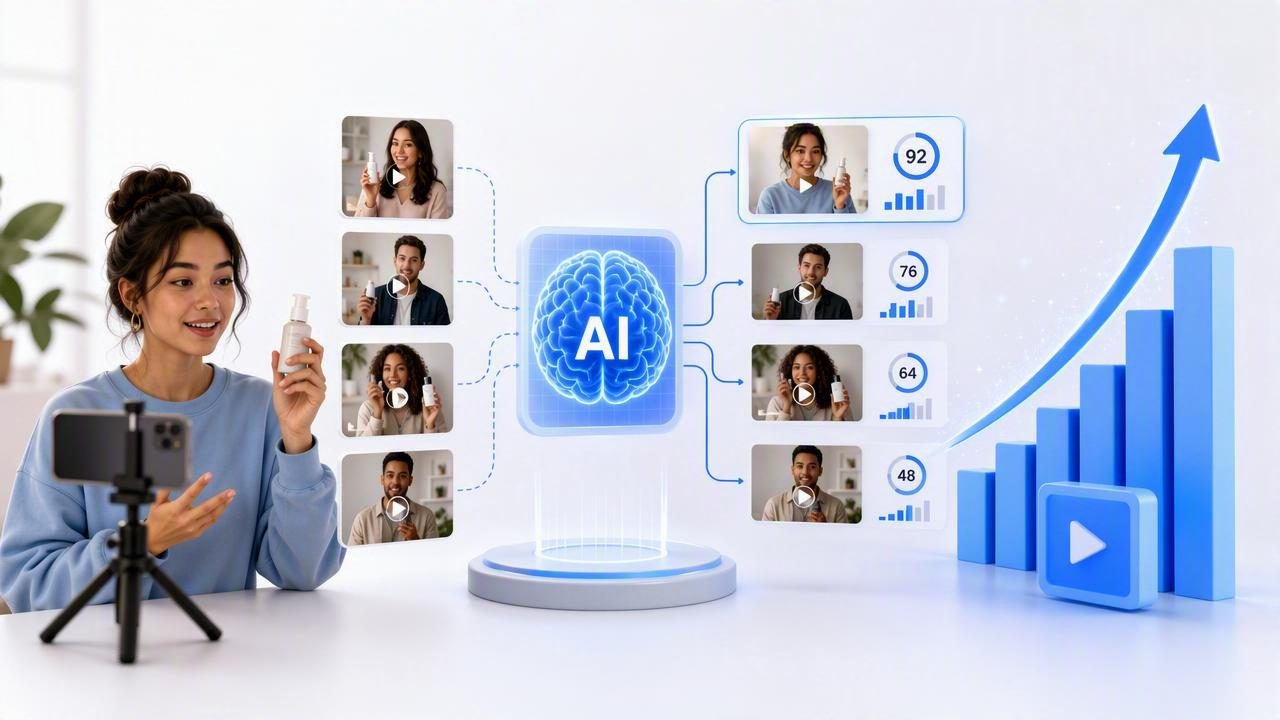
Paid social performance rarely depends on one perfect ad. It depends on a repeatable process for finding which messages, visuals, hooks, and formats motivate a specific audience to act. For ecommerce teams and growing brands, that process is becoming more efficient through UGC creative testing with AI.
AI does not replace strategy, customer insight, or authentic visual storytelling. Instead, it helps marketers turn existing product photography, customer feedback, creative concepts, and proven ad patterns into more testable video variations. The result is a faster learning loop: create, launch, measure, refine, and scale.
This guide explains how to build an AI-assisted UGC testing system, what to test first, which metrics matter, and how to turn creative results into better video marketing decisions.
What Is UGC Creative Testing With AI?
UGC creative testing is the structured practice of testing user-generated-content-style ads against one another to identify the creative elements that improve performance. These ads are designed to feel personal, native to social platforms, and grounded in real customer problems or product experiences.
Traditionally, producing enough UGC variations required recruiting creators, sending products, managing briefs, editing footage, and waiting for revisions. That approach can still be valuable, especially when genuine testimonials or creator authority are central to the campaign. However, it can be slow and expensive for early-stage concept testing.
AI expands the testing process by helping teams rapidly generate versions of an idea. For example, one product photo set can become multiple short-form video concepts with different opening hooks, benefit statements, text overlays, pacing, voiceovers, and calls to action.
The purpose is not to manufacture generic ads at scale. The purpose is to validate creative hypotheses before putting significant production budget behind a concept.
Why Creative Testing Matters More Than Ever
On platforms such as TikTok, Instagram Reels, YouTube Shorts, and Meta placements, audiences make fast decisions. A viewer may decide whether to keep watching in the first one or two seconds. Even strong products can underperform when an ad uses an unclear hook, weak product demonstration, or message that does not match the audience's awareness level.
Creative testing helps brands move away from assumptions. Rather than asking, “Do we like this ad?”, teams can ask more useful questions:
- Does a problem-first hook outperform a product-first hook?
- Do customers respond better to a demonstration or a lifestyle scenario?
- Which benefit produces the strongest click-through rate?
- Does social proof increase conversions for new audiences?
- Which visual opening earns the best three-second view rate?
These answers improve not only advertising results but also product pages, email content, organic social posts, and broader brand engagement. Every test becomes customer research.
The AI Advantage: More Variations Without Losing Direction
The biggest value of AI in content creation is speed with structure. A team can use AI to draft scripts, organize audience objections, generate overlay options, create rough storyboards, and transform product photography into motion-led assets. That creates more opportunities to test meaningful differences.
Still, volume alone is not a strategy. Publishing 30 nearly identical ads will not reveal much. Strong AI-assisted testing starts with a clear variable and a reason to test it.
| Creative Element | Example Variations | What It Can Reveal |
|---|---|---|
| Hook | Question, bold claim, relatable problem, surprising visual | What earns attention from the target audience |
| Primary benefit | Saves time, improves appearance, reduces mess, adds convenience | Which value proposition resonates most |
| Visual format | Product close-up, unboxing, before-and-after, lifestyle montage | Which storytelling approach creates interest |
| Proof | Review quote, result demonstration, feature comparison, statistic | What builds trust before purchase |
| Call to action | Shop now, learn more, see the difference, choose your shade | Which next step drives action |
Build a UGC Creative Testing Framework
1. Start With One Audience Problem
Every test needs a focused premise. Begin with a pain point, desire, or purchase barrier drawn from reviews, customer-service tickets, search queries, and comments. Avoid broad messages such as “high quality” or “best product.” They are difficult to make memorable and difficult to test.
For example, a skincare brand might identify three distinct angles: customers want to simplify their routine, reduce the appearance of dryness, or find a product that sits well under makeup. Each angle should become a separate creative test family.
2. Write a Clear Test Hypothesis
A hypothesis prevents random creative production. Use a simple format:
If we lead with [message or visual], then [audience] will be more likely to [desired action], because it addresses [specific motivation or objection].
Example: “If we open with a close-up of the product solving a common morning problem, then busy professionals will watch longer and click more often because they immediately recognize the use case.”
This makes the results easier to interpret. If the ad wins, you know what insight may have driven the outcome. If it loses, you have a productive next question.
3. Create a Modular Creative Brief
AI works best when it receives specific inputs. Build a brief with reusable modules rather than requesting a vague “viral UGC ad.” Include the product, audience, desired emotion, core benefit, proof point, visual assets, platform, duration, and prohibited claims.
Product: Insulated water bottle
Audience: Commuters who want cold drinks all day
Core benefit: Keeps drinks cold during long workdays
Hook options: “My desk essential” / “Why is my water still cold at 5 PM?”
Proof: Ice still visible after several hours
Format: 15-second vertical video
CTA: “See the colors”
With this framework, AI can help generate disciplined variations while your team maintains brand accuracy and compliance.
4. Test One Major Variable at a Time
When every component changes at once, it becomes difficult to understand why one ad performed better. For early tests, keep the product, offer, audience, and core structure consistent. Change one major variable, such as the hook or benefit.
Once you identify a winning direction, test smaller refinements. For instance, after learning that a problem-first hook works best, compare three versions of that hook with different wording, opening visuals, and pacing.
A Simple Testing Matrix for UGC-Style Video Ads
A practical initial batch does not need to be huge. Start with six to 12 distinct ads organized around a few meaningful themes.
- Problem awareness: “Tired of carrying lukewarm drinks?”
- Product demonstration: Show the product in use within the first seconds.
- Benefit-led story: Focus on the outcome the customer wants.
- Social proof: Use a real review, rating theme, or commonly praised feature.
- Comparison: Contrast the old way with the improved experience.
- Objection handling: Address a concern such as size, durability, fit, price, or ease of use.
Within each category, use AI to create alternate captions, voiceover lines, visual sequences, and on-screen text. Maintain enough consistency that the tests remain comparable.
How to Evaluate Creative Performance
The best metric depends on campaign objectives and funnel stage. A top-of-funnel video may be successful because it holds attention, while a retargeting ad should be assessed more heavily on conversion efficiency.
- Hook rate or three-second view rate: Indicates whether the opening earns attention.
- Thumb-stop rate: Measures how effectively the ad interrupts passive scrolling.
- Average watch time: Shows whether the story sustains interest.
- Click-through rate: Signals message-to-offer relevance.
- Conversion rate: Indicates whether traffic takes the intended action.
- Cost per acquisition: Helps compare business efficiency across creative concepts.
- Frequency and fatigue: Reveals when a formerly strong ad needs fresh variations.
Do not declare a winner based on a tiny number of impressions. Give ads enough spend and time to collect useful data, while accounting for platform learning phases, audience overlap, seasonality, and offer changes.
Common Mistakes to Avoid
Testing without a consistent offer. If price, landing page, shipping terms, and audience all change simultaneously, creative results become unreliable.
Optimizing only for clicks. Clickbait can improve click-through rate while hurting conversion quality. Review downstream metrics before scaling.
Making every ad look polished and corporate. UGC-style content often works because it is direct, specific, and platform-native. Authenticity does not mean poor quality; it means the presentation feels useful rather than overproduced.
Using unverified claims. AI-generated scripts and overlays must be reviewed for accuracy, legal compliance, and brand safety. Never imply results the product cannot support.
Failing to document learnings. Store results in a creative library. Note the audience, hook, format, message, performance, and interpretation. This prevents teams from repeatedly testing the same ideas.
Turn Winners Into a Scalable Content System
When an ad wins, do not simply increase budget and wait for fatigue. Extract the underlying pattern. Perhaps viewers respond to a visible product demonstration, a relatable daily frustration, or a concise review-led script. Turn that insight into a new round of variations.
A useful workflow is: identify the winning angle, develop three new hooks, add two new proof points, and create versions for different placements. This approach preserves what worked while giving the platform fresh creative inventory.
For brands with strong product photography but limited video resources, photo-to-video workflows can make this iteration much more accessible. Tools such as UGCMade can help transform existing product visuals into dynamic video assets that support faster creative experimentation.
Final Takeaway
UGC creative testing with AI is most effective when it combines speed with intentionality. Start with real customer insight, define a clear hypothesis, isolate important variables, and measure results against the right business goal. AI can accelerate production, but thoughtful testing is what turns more content into better decisions.
By treating every ad as a learning opportunity, brands can build a stronger visual storytelling engine, improve brand engagement, and continuously discover the messages that move customers from attention to action.