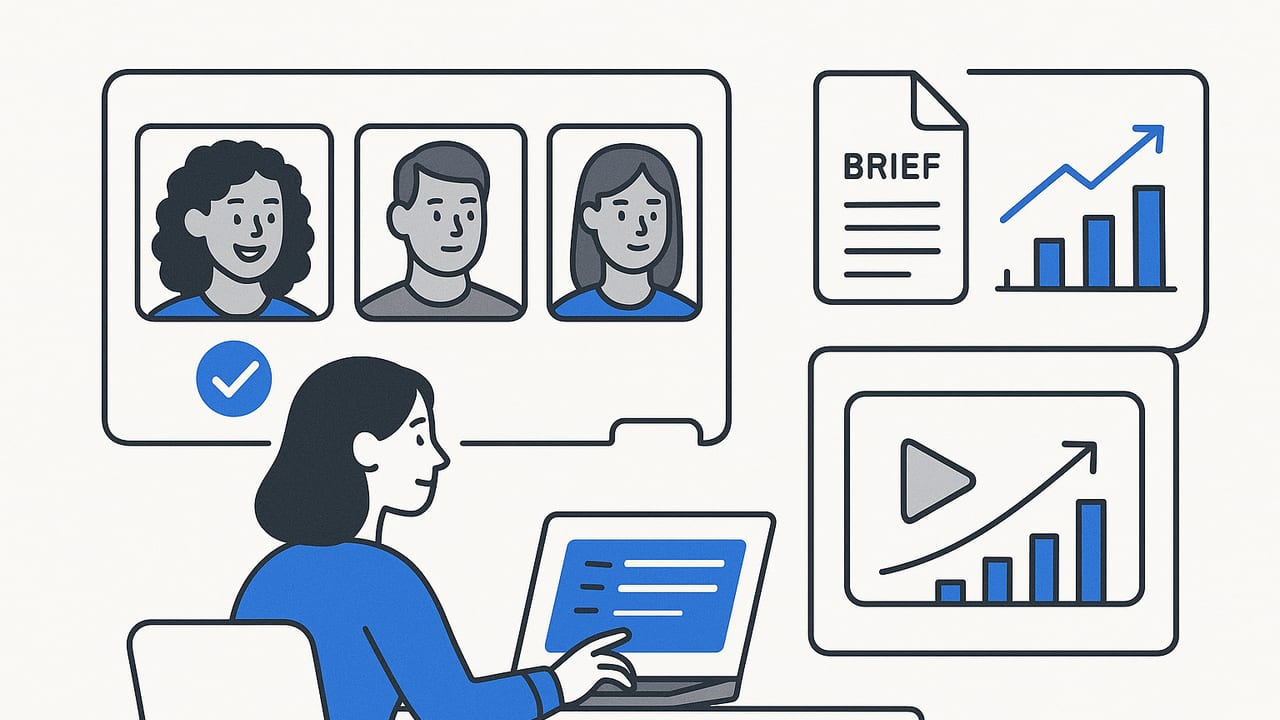
In an endless scroll of content, personality is the differentiator. Audiences stop for people who feel familiar, credible, or entertaining. That’s why “ugc creators personality” has become a strategic lever: the right on-screen persona can lift hook rate, watch time, trust, and conversions—often more reliably than any single edit or angle.
People buy from people, not logos. Personality turns product demos into decisions.
This guide shows how to identify, brief, and test creator personality for performance. You’ll get a practical rubric, a persona-product fit matrix, script examples, and testing workflows to turn personality into measurable outcomes.
Why UGC Creator Personality Drives Performance
Platform algorithms optimize for attention and satisfaction. Personality is a shortcut to both because it carries:
- Authenticity: Viewers infer intent. A creator’s delivery signals sincerity or hype, shaping perceived risk.
- Relevance: Micro-identities (new mom, sneakerhead, engineer, esthetician) map to product use-cases and community language.
- Memory: Distinct voices, catchphrases, and cadence become mental availability for your product.
- Conversion Momentum: Personality lowers cognitive load by making complex benefits feel obvious and relatable.
In short, UGC creators’ personality is the interface between your product and the viewer’s decision-making. It shapes thumb-stop probability, watch time, and downstream CTR/CPA.
The Personality-to-Performance Loop
What you choose upstream determines the metrics you can win downstream:
- Hook rate (3-second views / impressions) responds to high-energy, pattern-breaking intros.
- Hold rate (50% watch completion) favors clear structure and relatable conflict.
- CTR improves with credible proof and specific calls-to-action delivered in a confident, helpful tone.
- Conversion rate rises when the persona matches the buyer’s self-image or aspiration.
The Personality-Product Fit Matrix
Not every persona fits every product. Use this matrix to cast creators with intent.
| Archetype | Personality signals | Best for products | Platform fit | Risks |
|---|---|---|---|---|
| The Expert | Calm, authoritative, cites facts/data | Skincare actives, supplements, tech gadgets | YouTube Shorts, TikTok, IG Reels | Can feel dry; needs strong visuals |
| The Bestie | Warm, chatty, personal anecdotes | Beauty, fashion, wellness, home | TikTok, IG Reels | May lack hard proof; watch for vagueness |
| The Entertainer | High energy, humor, quick cuts | Snacks, novelty, lifestyle accessories | TikTok, Shorts | Jokes can overshadow benefits |
| The Problem-Solver | Before/after, step-by-step clarity | Cleaning, organization, productivity | All short-form platforms | Needs clear pain points to land |
| The Minimalist | Low-energy, aesthetic, ASMR vibes | Home decor, stationery, tech accessories | IG Reels, Pinterest Video, TikTok | Low hook energy; rely on visuals |
| The Skeptic/Tester | “I didn’t believe this would work” arc | Bold claims: stain removers, whitening, tools | TikTok, Shorts | Must deliver visible proof |
| The Builder/Tinkerer | Hands-on, process, tips | DIY, hardware, software tools | YouTube Shorts, TikTok | Longer explanations can drag |
Choose one or two archetypes per product line and test systematically rather than guessing each brief.
A Rubric to Evaluate UGC Creators’ Personality
Use a simple, repeatable scorecard to forecast fit before you spend on production.
| Dimension | What to look for | Score (1–5) |
|---|---|---|
| Energy Control | Can modulate tone for hook vs. explanation | 1=flat, 3=steady, 5=dynamic |
| Credibility | Voice, eye contact, specificity, no over-claiming | 1=low, 3=some proof, 5=trustworthy |
| Relatability | Feels like “one of us”; uses community language | 1=out of touch, 3=neutral, 5=hyper-relevant |
| Clarity | Explains benefits simply; good pacing | 1=confusing, 3=okay, 5=crisp |
| Aesthetic Fit | Visual style matches brand and category | 1=clash, 3=adjacent, 5=on-brand |
| Structure | Uses hook-problem-solution-proof-CTA rhythm | 1=rambling, 3=some structure, 5=tight |
| Proof Delivery | Shows results, demos, numbers, textures | 1=tells, 3=some show, 5=shows clearly |
Shortlist creators with an average score of 3.8+ in your top three dimensions. For regulated or high-trust categories, weigh Credibility and Proof Delivery more heavily.
How to Source Creators by Personality
- Write a casting call centered on personality signals. Instead of “Skincare creator needed,” use “Calm, confident explainer with experience describing actives and textures; comfortable with close-up demo.”
- Request a 15-second audition hook. Ask for a selfie clip delivering a hypothetical hook about your category. You’ll hear cadence, clarity, and energy control instantly.
- Ask for a micro-proof moment. Have them show a quick demo with any household analog (e.g., lotion texture) to assess framing and proof instincts.
- Check their comments section. Audience replies reveal trust. Look for “I bought because of you” vs. “this feels like an ad.”
Briefing for Personality Without Over-Scripting It
Great briefs protect the creator’s voice while locking in performance anchors.
Brief Title: 30s Problem-Solver UGC for Shower Cleaner

Audience: Renters with small bathrooms; hate scrubbing; budget-conscious

Must-Show Proof: Spray on soap scum, 60-second dwell, wipe with one pass

Hook Options (choose 1, rephrase in your voice):
- I stopped scrubbing my shower. Here’s the shortcut.
- If your glass looks like this, try this instead.

Key Lines (say in your own words):
- What it replaces (harsh bleach, long scrubs)
- How it works (foaming surfactants)
- Time saved (30 seconds)
- Scent (unscented option)

Shots (order flexible):
- Close-up of scum
- Spray + timer on screen
- One-pass wipe reveals result
- Before/after split

CTA (choose 1):
- I grabbed mine with a coupon in the link.
- Link has the unscented one I’m using.

Disclosures:
- #ad; real results; no over-claiming; follow on-screen text template
Note how the brief locks proof and structure while giving space for the creator’s own personality and language.
Personality-Specific Hooks and CTAs
Tailor openings and closes to the archetype to maximize intent and trust.
- Expert
Hook: “Derms like this for one reason: the active actually penetrates.”
CTA: “I’ll link the exact 0.3% formula below; check the ingredient list.” - Bestie
Hook: “Okay, this is your sign to fix the 3pm slump without coffee.”
CTA: “I saved my fave flavor in the link—tell me which one you get.” - Entertainer
Hook: “I tried the ‘no scrub’ hack so you don’t have to—here’s what happened.”
CTA: “If you’re lazy like me, link’s there. Don’t judge.” - Problem-Solver
Hook: “Two steps to stop your glasses fogging—works in 10 seconds.”
CTA: “Grab the kit I used in my link; it’s the one with the microfiber.” - Minimalist
Hook: “No talking. Just watch this go from cloudy to clear.”
CTA: “Linked the exact bottle and cloth.” - Skeptic/Tester
Hook: “I didn’t think this would work. I was wrong.”
CTA: “If you want to test it yourself, link has the small bottle.” - Builder/Tinkerer
Hook: “Here’s the 3-minute setup that doubled my Wi‑Fi range.”
CTA: “Parts list and firmware link are below.”
Testing Framework: Prove Personality, Don’t Guess
Design your experiments around personality variables, not just creative edits.
- Define the objective metric. For top-of-funnel, optimize Hook Rate (3-second views / impressions). For mid-funnel, use 50% hold. For lower-funnel, use CTR and CPA.
- Control for content. Keep script beats, shots, and offer identical across variants, changing only the creator/personality archetype.
- Run parallel spend. Split budget evenly across variants for at least 5000 impressions each per platform to stabilize early signals.
- Read the right signal by stage.
- Hook-focused platforms (TikTok): pick winners on thumb-stop and 50% hold.
- Conversion-focused channels (Meta): pick on CTR and CPA after 1–2k link clicks.
- Tag versions precisely. Use naming such as “PSolver_Aud1_Calm” vs. “PSolver_Aud1_Entertainer.”
Map metrics to likely personality tweaks:
- Low hook, high hold: Boost opening energy, pattern breaks, or visual contrast. Keep persona.
- High hook, low hold: Over-hyped open. Dial back to credibility or add quick proof early.
- Good hold, low CTR: CTA mismatch. Shift tone to urgency or specificity (“the 0.3% serum” vs. “this serum”).
- Good CTR, weak conversion: Persona builds curiosity but not trust. Add third-party proof or a cost anchor.
Editing Choices That Preserve Personality
Editing can amplify or flatten a creator’s personality. Aim to enhance, not overwrite.
- Pacing: Match cut speed to persona. Entertainers can take faster cuts; Experts need breathing room for claims.
- Captions: Style captions to voice. A minimalist uses thin, low-contrast type; an Entertainer uses bold, kinetic text.
- Music: Underscore, don’t drown. If the voice carries trust, keep music soft or none.
- Proof Moments: Prioritize uncut demos and on-screen timers for skeptics and problem-solvers.
- B-Roll: Let Besties insert lifestyle cutaways that humanize the product in everyday scenes.
When You Don’t Have a Live Creator: Simulating Personality
Sometimes you have only product photos or stock clips. You can still embed a “personality layer” without a face on camera.
- Voiceover Tone: Choose a VO read that matches an archetype (calm expert, warm bestie, energetic entertainer). Record two reads to test.
- POV Captions: Write in first person (“I stopped scrubbing and did this instead”) to mimic a creator’s diary-style delivery.
- On-Screen Hand Model: Hands-in-frame demos imply a human presence without showing a face, great for ASMR/minimalist style.
- Typography as Persona: Serif and muted colors for Expert; playful sans with motion for Entertainer.
- Proof Widgets: Add “timer,” “ingredient callouts,” or “before/after split” overlays to carry credibility.
- Micro-Scenes: Build a 3-shot story: problem visual, satisfying action, clear result. Keep the rhythm of a human story even if no person is visible.
If your workflow relies on existing product photos, consider tooling that can turn stills into short videos while preserving a chosen tone of voice. A light persona layer—VO, captions, overlays—can transform static assets into personality-driven clips. Tools like UGCMade help teams convert photos into engaging videos and can align motion, captions, and pacing to a defined persona without requiring a full shoot.
Compliance and Brand Safety With Personality
Personality must never compromise compliance. Protect your brand and creators by systematizing guardrails.
- Claims: Ban absolutes (“cures,” “guaranteed”). Prefer “helps,” “designed to,” and measurable outcomes (“in 30 seconds”).
- Disclosures: Require #ad or in-video disclosure within the first few seconds, readable and spoken when possible.
- Footnotes: For data claims, add small on-screen references (e.g., “based on 50-user survey”).
- Regulated categories: Pre-approve scripts; use the Expert or Problem-Solver archetype to signal responsibility.
Putting It All Together: A Lightweight Workflow
- Choose the archetype best suited to your product and audience (use the matrix).
- Score 5–10 creators with the rubric; shortlist 2–3 above your threshold.
- Brief for structure and proof, not word-for-word lines; include multiple hook/CTA options.
- Produce 2–3 variants per archetype with the same beats.
- Test in parallel with clear naming and stage-appropriate metrics.
- Iterate on personality levers first (tone, hook type, proof placement) before overhauling the entire creative.
Key Takeaways
- “Ugc creators personality” is a performance lever, not just a vibe—cast and measure it deliberately.
- Start with a persona-product fit hypothesis; validate with controlled tests.
- Use a rubric so selection is repeatable and defensible.
- Lock proof and structure in your brief while letting the creator’s voice breathe.
- If you lack on-camera talent, simulate personality with VO, captions, and proof-driven motion.
Brands that operationalize personality rapidly outlearn competitors. Choose personas with intent, brief for outcomes, and test with discipline. Your media will feel more human—and your metrics will show it.